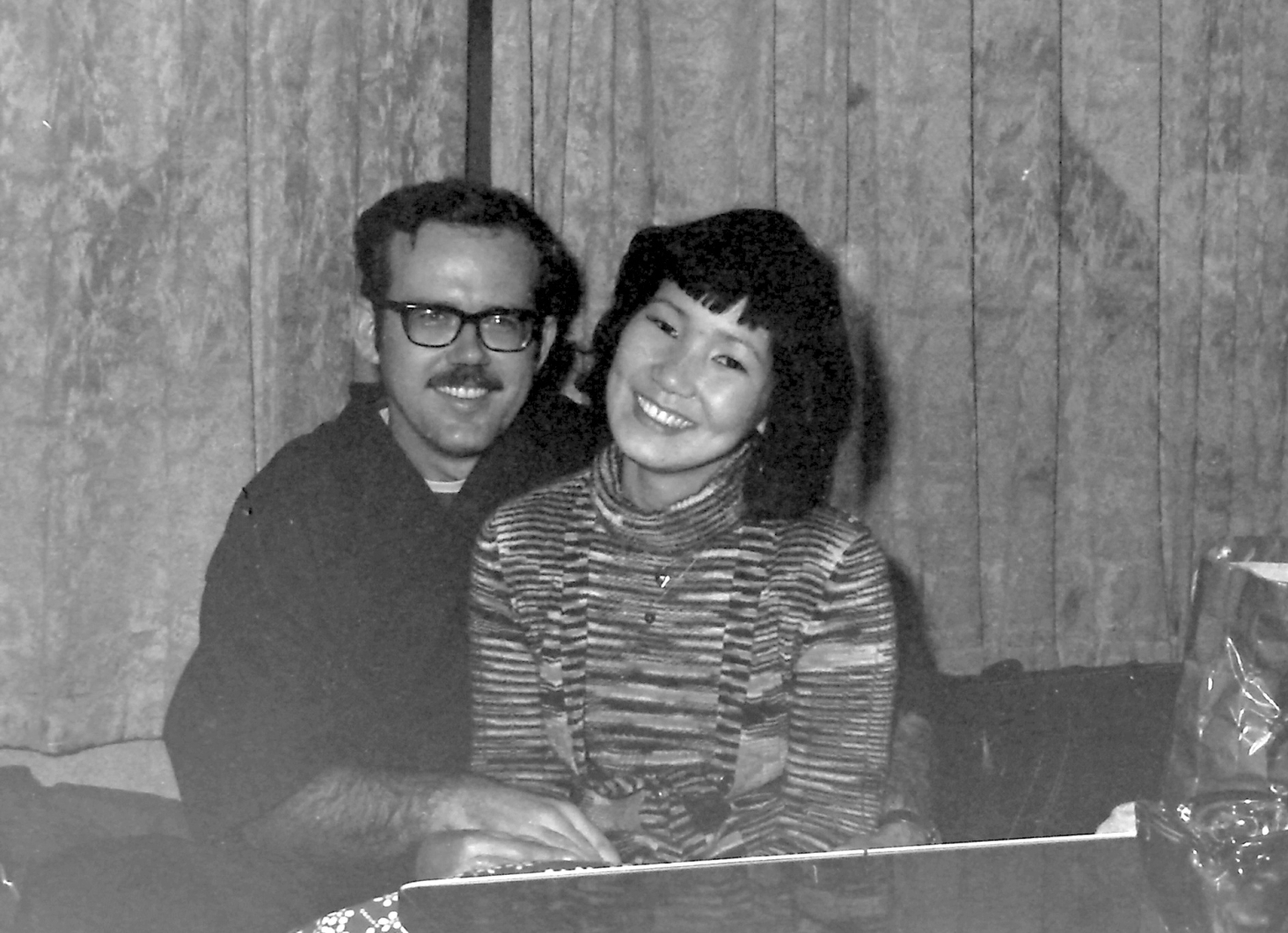
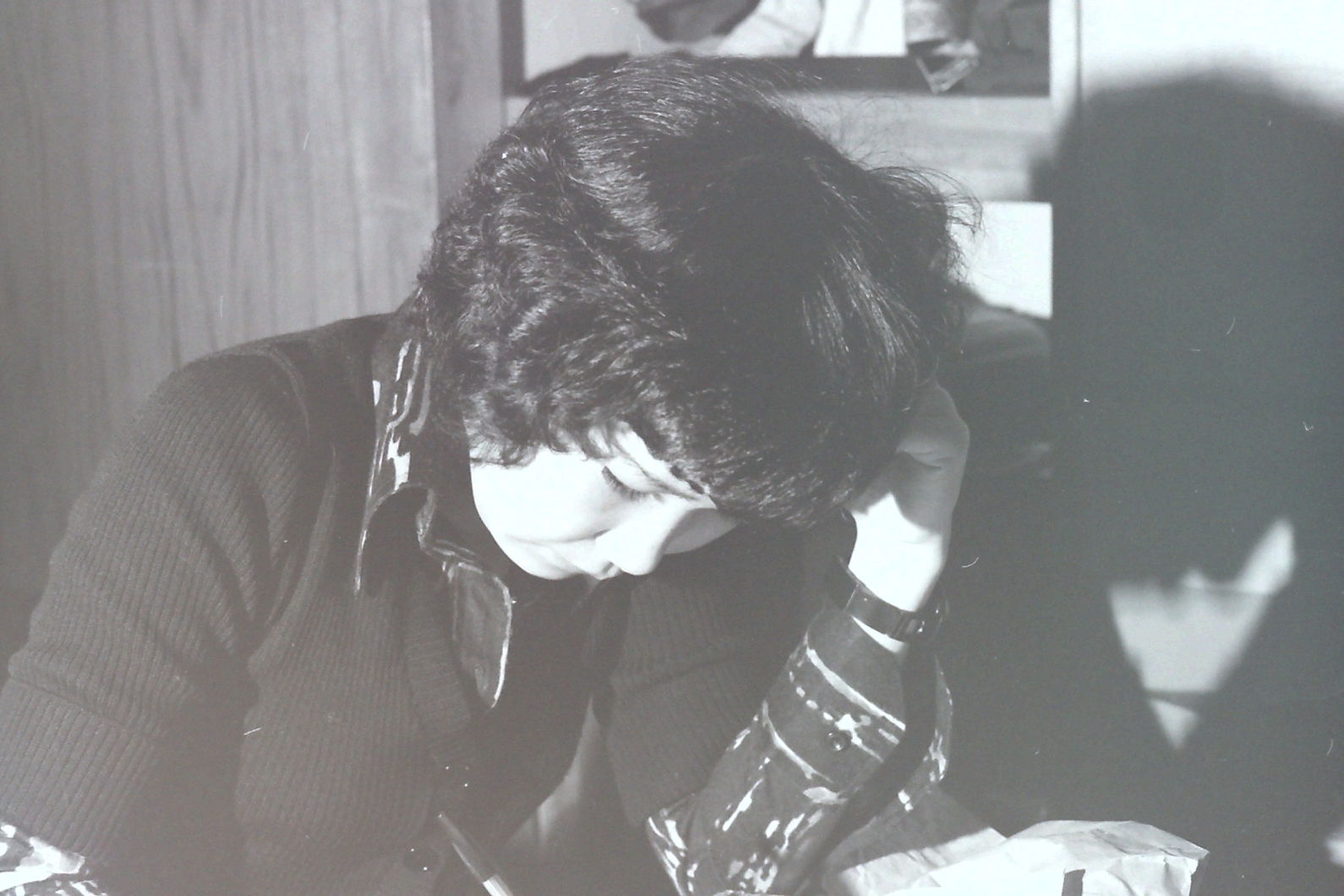
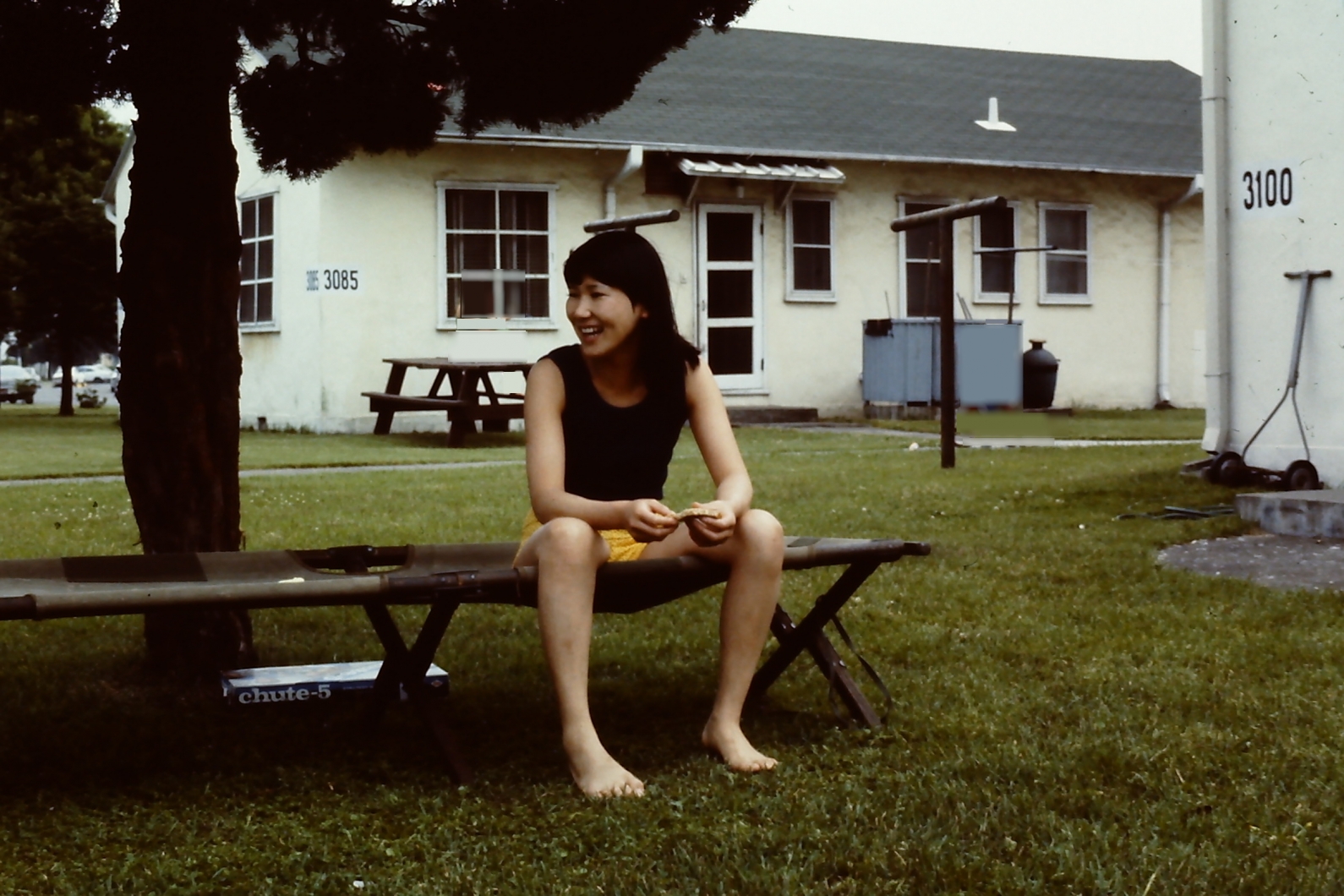
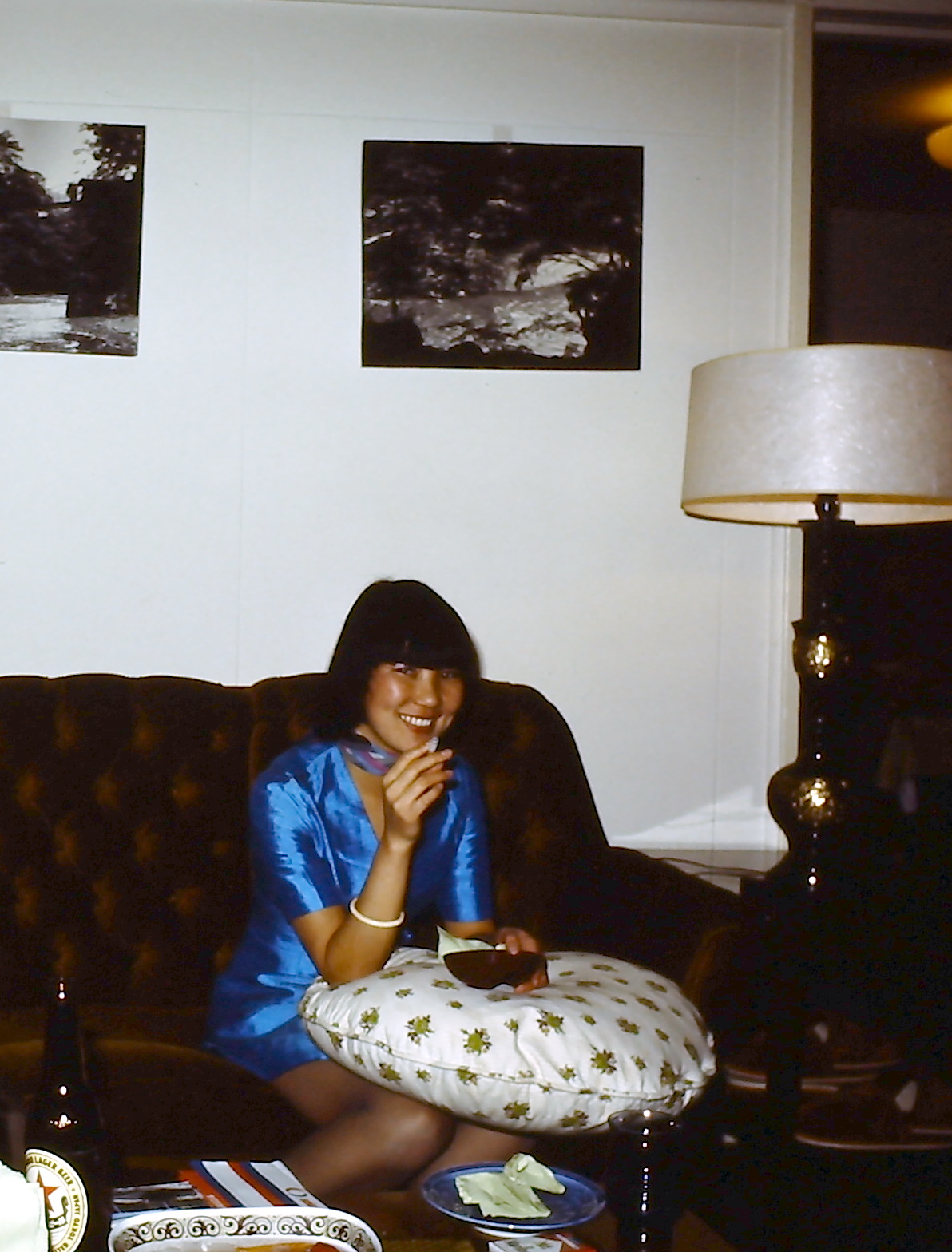
On this web site, I will share with you some stories and pictures from the time when I lived in Japan as a member of the United States Air Force, and from various visits that my wife, Ritsuko, and I have made there since my departure from the military in 1978. As you browse the site, please note that clicking (or tapping if using a phone or tablet) on any of the images will enable you to see an enlargement of the picture, clicking on it again will take it back to original size. Also, many words are highlighted to show the availability of a tooltip, which will provide you with more information about the word, and are invoked by hovering the mouse pointer over it (or tapping if using a phone or tablet).
I will add content to the site periodically, so please visit often.
Japan has dramatically tightened its business manager visa requirements, raising the minimum capital requirement from ¥5 million to ¥30 million and introducing stricter conditions for foreign entrepreneurs.
The…Finnish woman held on suspicion of smuggling cocaine into Japan Thu, 08 Oct 2026 07:35:10 +0000
The Tokyo Metropolitan Police Department’s Drug and Firearm Control Division and the Haneda Customs Branch of Tokyo Customs have arrested a 56-year-old unemployed Finnish woman on suspicion of…Pro-Palestinian march in Shibuya Wed, 07 Oct 2026 21:20:41 +0000
About 1,000 demonstrators march through central Shibuya in Tokyo on Wenesday night during a pro-Palestinian and anti-war demonstration marking three years since the start of the war in…Trump says he deserves Nobel Peace Prize but has doubts he will get it Thu, 08 Oct 2026 03:01:24 +0000
U.S. President Donald Trump, who waged war with Iran and has yet to broker peace in Ukraine, said on Wednesday that he should win the Nobel Peace Prize but acknowledged…Microsoft pushes AI vision with new, expensive Surface laptop Wed, 07 Oct 2026 21:36:33 +0000
President Donald Trump has turned emergency relief into a campaign talking point in the final sprint to the midterm elections, approving disaster declarations in consequential states and coupling…
On May 9, Ritsuko and I returned from our 2017 Japan Trip. Everything pretty much came together as planned, and aside from both of us coming down with colds in the last week, there were no unpleasant surprises.
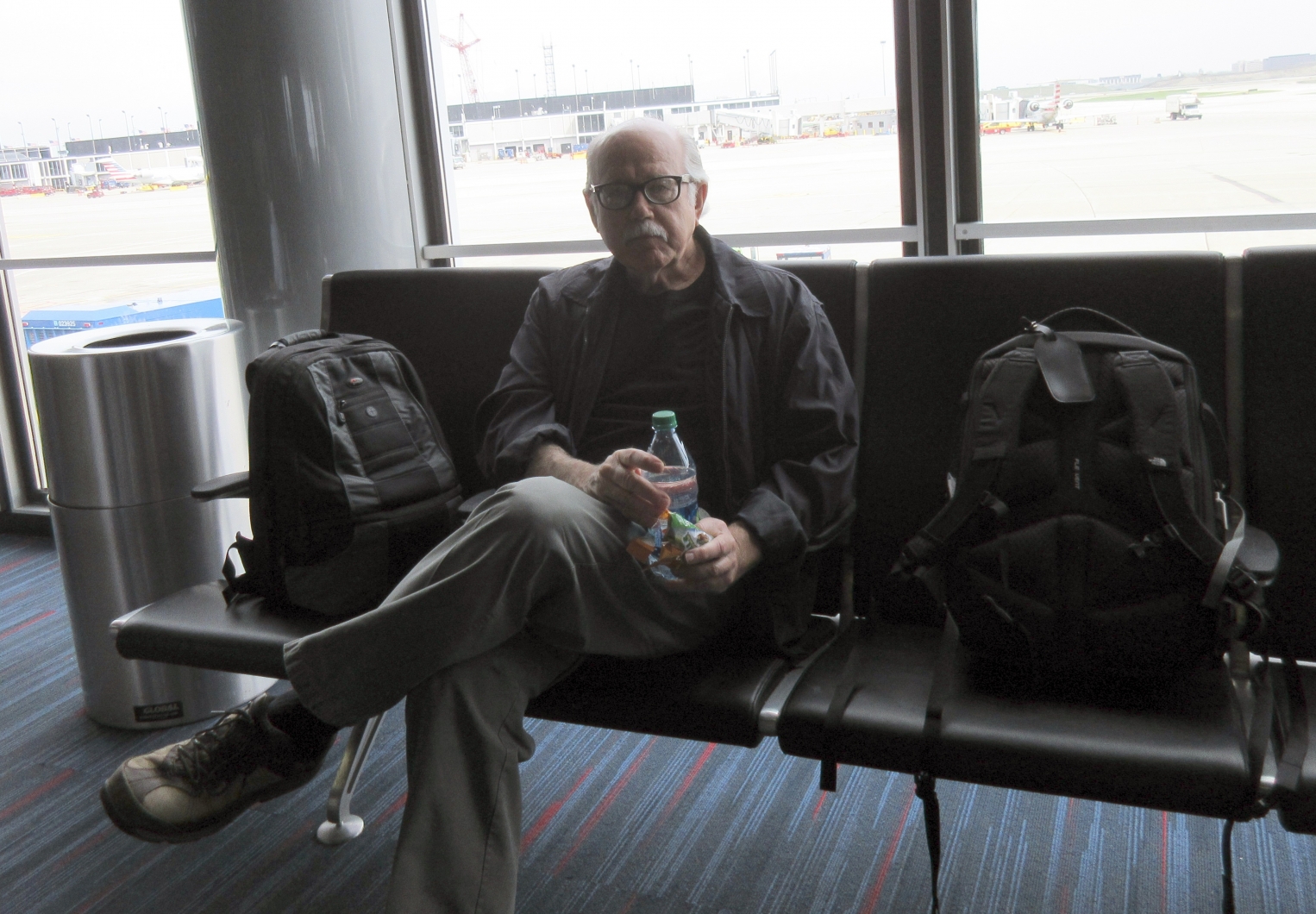
At Chicago O'Hare, waiting to board our flight to Tokyo
Flying in economy class for 13 hours is not a pleasant experience, but it was tolerable. This year, we flew on Japan Airlines instead of ANA, on which we have flown on our previous three trips. JAL's widebody 777's are set up with a 3-3-3 seating configuration in the economy cabin as opposed to the 3-4-3 setup on ANA. Also, there is slightly more leg room on JAL. These small differences made for a huge improvement in overall comfort.
Improvements in comfort notwithstanding, by the time that we arrived at Narita, Tokyo International, I felt like I was some kind of creature that had been squeezed out of a tube, and was attempting to regain human form as I slithered into the jetway. Things got better after that. Immigration, customs, and the JR East office were not congested, and we were quickly processed, received our JR Rail Passes, and were on our way to Tokyo via the Narita Express train (NEX).
I'll try to fill in the details on some of the highlights of the trip later, but here is the a broad overview of where we went and where we stayed:
We spent the first night near Tokyo Station across the street from the Yaesu North Entrance at Hotel Ryumeikan Tokyo. We also stayed here on the first night of our 2016 trip. The hotel is secure, clean, and well appointed. Although it might seem rather pricey for the size of room, given the location where most hotels in the area cost double or more, it is a bargain. If you need to depart Tokyo Station early in the morning, the convenience of being across the street from one of the entrances near the Shinkansen platforms is worth the extra expense.
The next morning, we traveled by train to Kagoshima, where we spent seven nights in Kagoshima city at the Silk Inn Kagoshima, about 2 blocks from Kagoshima-Chuo Station. Booking a hotel near the station for seven contiguous nights was a challenge this year. This was our first stay at the Silk Inn, and we were quite happy with the hotel. The location was good, the hotel was clean and quiet, and the staff was excellent. We will definitely stay there again. During our stay in Kagoshima, we traveled by train several times to the north into rural Kagoshima Prefecture, where we got together with several family members. We also visited the newly constructed museum on the East China Sea coast in the town of Hashima that is dedicated to the Satsuma Students and their voyage to England in the 1860's. Another highlight of our stay in the Kagoshima area was a return visit to the Uenohara Jomon Period Archaeological Museum and the Kagoshima Prefecture Archaeology Center in Uenohara.
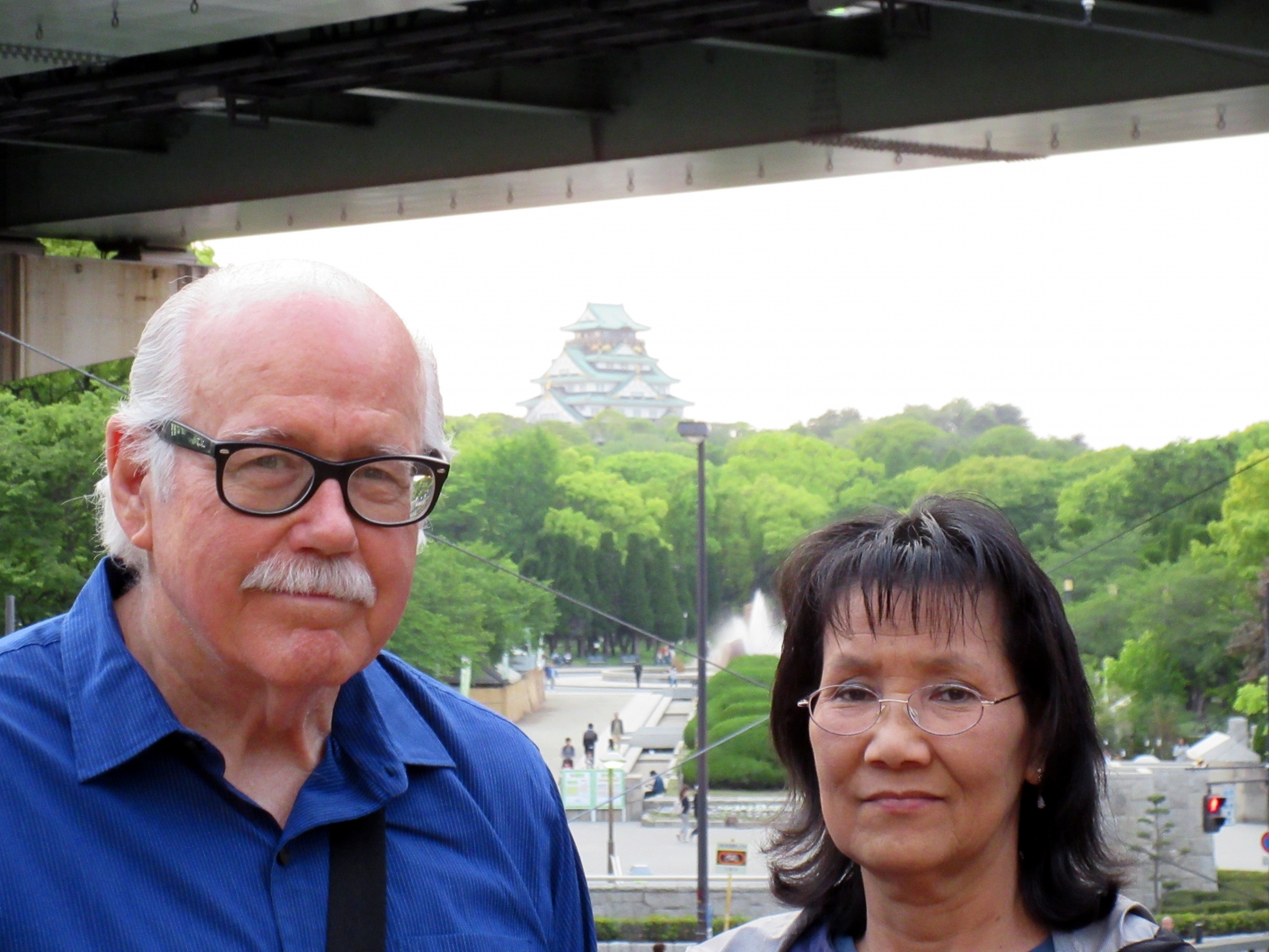
Bob and Ritsuko with Osaka Castle in the background - May 2017
From Kagoshima, we traveled by Shinkansen to Kyoto, where we spent six nights, staying at the Daiwa Roynet Hotel Kyoto-Hachijoguchi. This was our first time to stay in this hotel, and we were very pleased. It is a well appointed hotel located a couple of blocks south of Kyoto Station, and a block and a half north of the Karasuma Subway Line Kujo Station. The room was large enough so that we were not tripping over one another, and we had adequate space for luggage. The hotel serves a super breakfast buffet every morning that includes Japanese and western breakfast items. Last year, we left Kyoto a couple of weeks before the new Kyoto Rail Museum opened. This year, visiting the rail museum was on my must see/must do list. Our stay in Kyoto was during Golden Week, therefore, with the exception of the Kyoto Rail Museum and Nishiki Market, and other popular shopping areas, we avoided the more popular tourist destinations in order to avoid the crowds, opting instead for sites less visited or more remote.
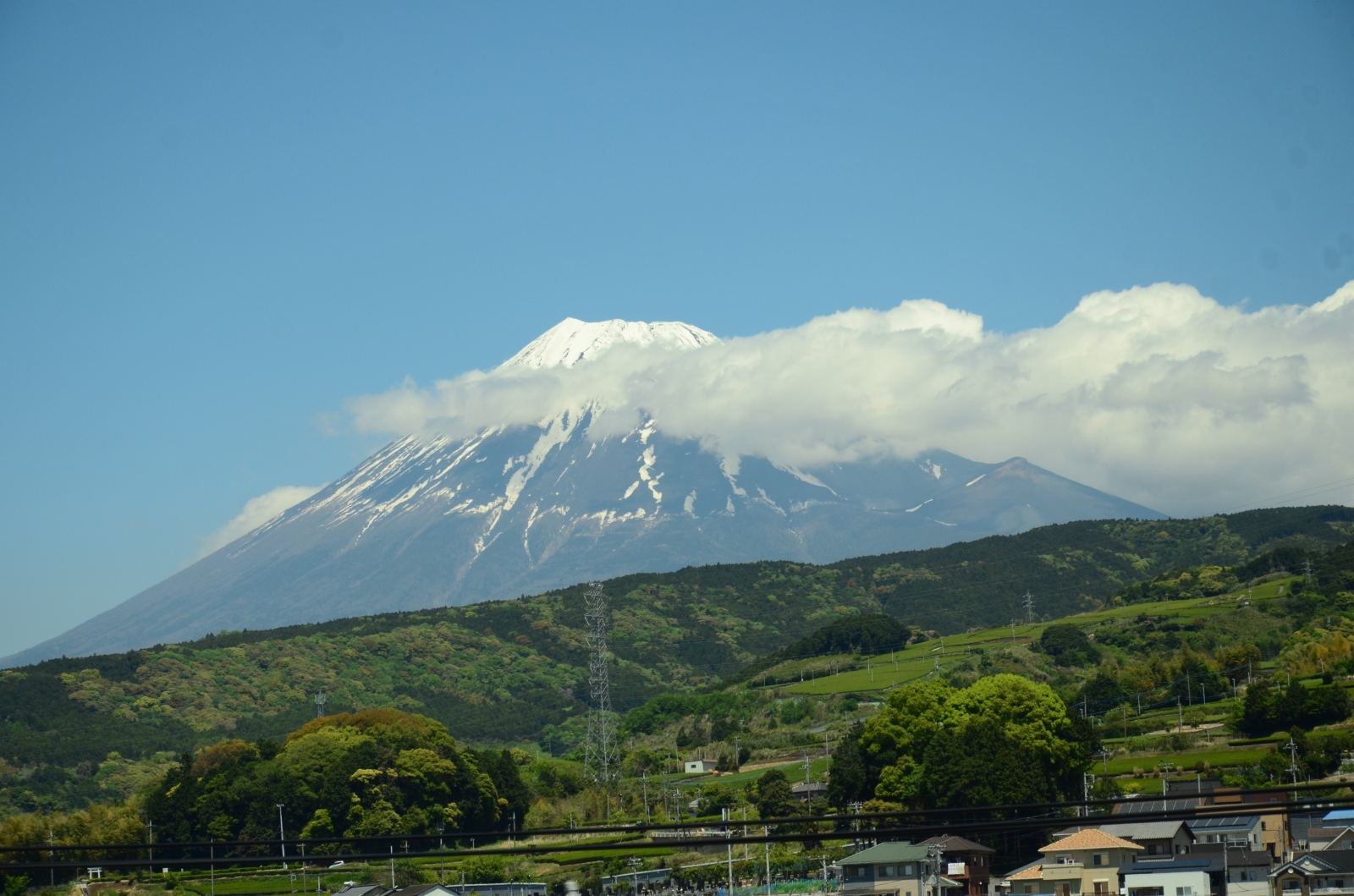
Mount Fuji viewed from the Shinkansen en route to Tokyo
The last leg of our journey took us back to Tokyo for the last week of our trip. For the third consecutive trip, we stayed in Asakusa near Sensoji Temple at a small residence hotel, B:Conte Asakusa. Ritsuko and I love staying in Asakusa. Although it does get rather crowded at times, especially on holidays, it is a laid back area with a rich history and lot of great small restaurants. We didn't do a lot during this leg of our trip. We visited some familiar haunts, ate some great food, and mostly hung out and relaxed as we prepared for the journey home.
Overall, it was a great trip, and although we just returned, we are already thinking about our next Japan trip, whenever that will be.
During our visit to Japan in April-May 2012, we decided to spend a day in Hiroshima. We have been through the city many times, only stopping at the train station briefly while aboard a Shinkansen. It is a place where I have always wanted to visit, but we were always in too much of a hurry to get someplace else. When planning this trip, we set aside a day, and put it into our travel plan.
After spending a few days in Southern Kyushu, we departed Satsumasendai early on a Saturday morning, boarding a Shinkansen headed north. We arrived in Hiroshima just before noon, left our bags at the hotel, had lunch near the station, and then ventured on to the Genbaku Dome, Memorial Peace Park, and Hiroshima Memorial Museum.
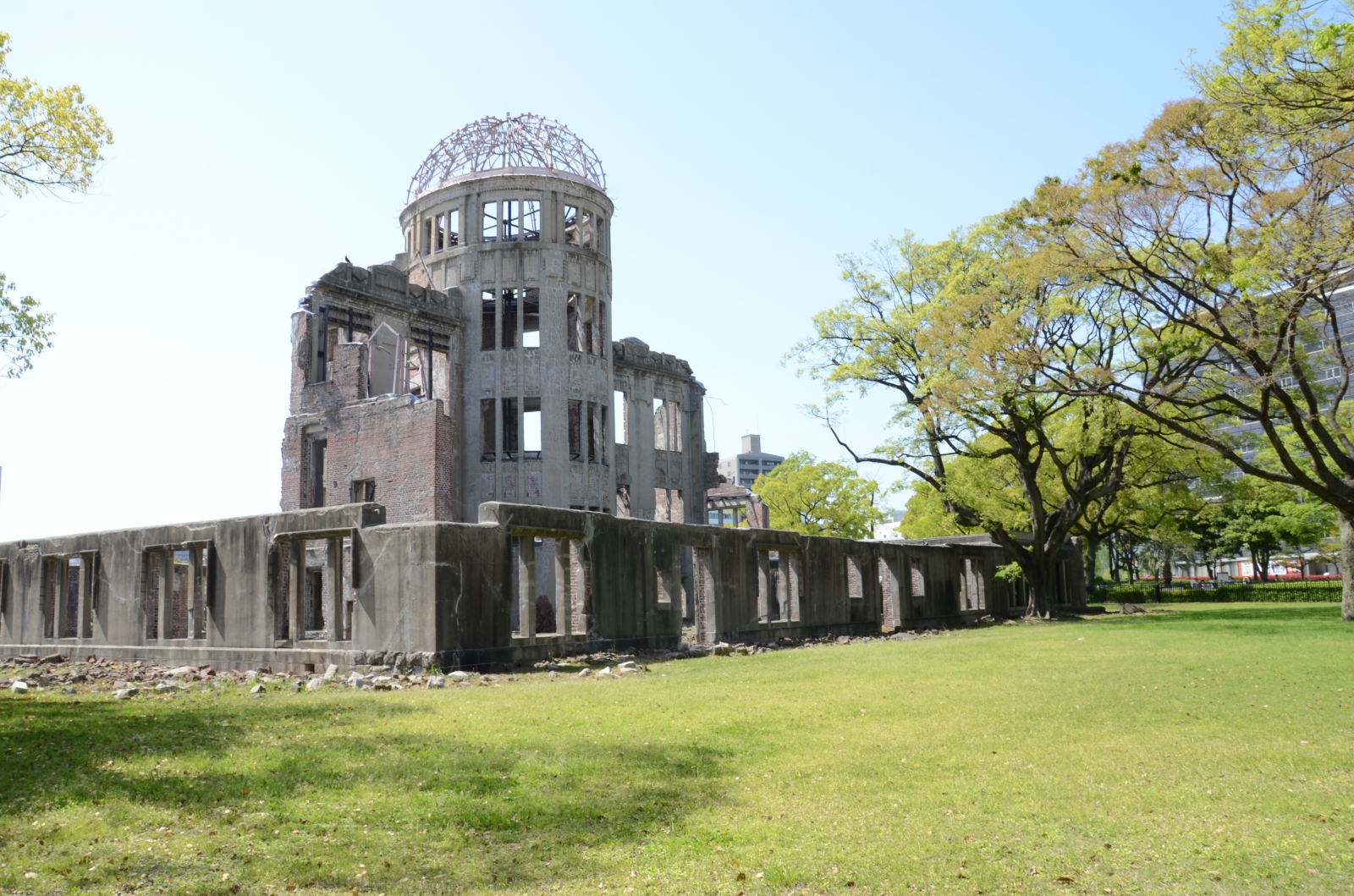
Hiroshima Genbaku Dome - a somber reminder of the destructive force of nuclear weapons
The Genbaku Dome was originally constructed in the early 20th century to serve as the Hiroshima Prefecture Commercial Exhibition Hall. After the atomic bombing on August 6, 1945, it was one of the very few structures in the central part of the city of Hiroshima that were not completely reduced to ash and rubble. As the city was reconstructed, the remaining structure was preserved as it was after the bombing.
Today, the shattered structure stands as part of a memorial in the middle of the once again vibrant port city of Hiroshima. The dome, Memorial Peace Park and Memorial Museum have been designated as a UNESCO World Heritage site, serving as a memorial to the 70,000 people who were instantly killed when the bomb detonated, and to the additional 70,000 people who were fatally injured during the blast and perished later. It was a humbling and solemn experience to stand on the ground where so many perished instantly at the unleashing of such an enormous power, and a somber reminder of the devastation caused by nuclear warfare.
Here is a video slide show of some photos that I took that day.
I would recommend for anyone to visit Hiroshima if they have the opportunity. The memorial is a haunting reminder that the destructive force of nuclear weapons should never again be unleashed upon humanity.
"Life is a series of natural and spontaneous changes. Don't resist them; that only creates sorrow. Let reality be reality. Let things flow naturally forward in whatever way they like." -- Lao Tzu, 4th Century BCE
The biggest, most important change in my life was when Ritsuko and I decided to get married, and to spend the rest of our lives together. Not long ago, we were reminiscing about our early days together, and I told her, "you know, it was a long time ago, but for the life of me, I can't remember ever having proposed to you, nor can I recall that you ever proposed to me."
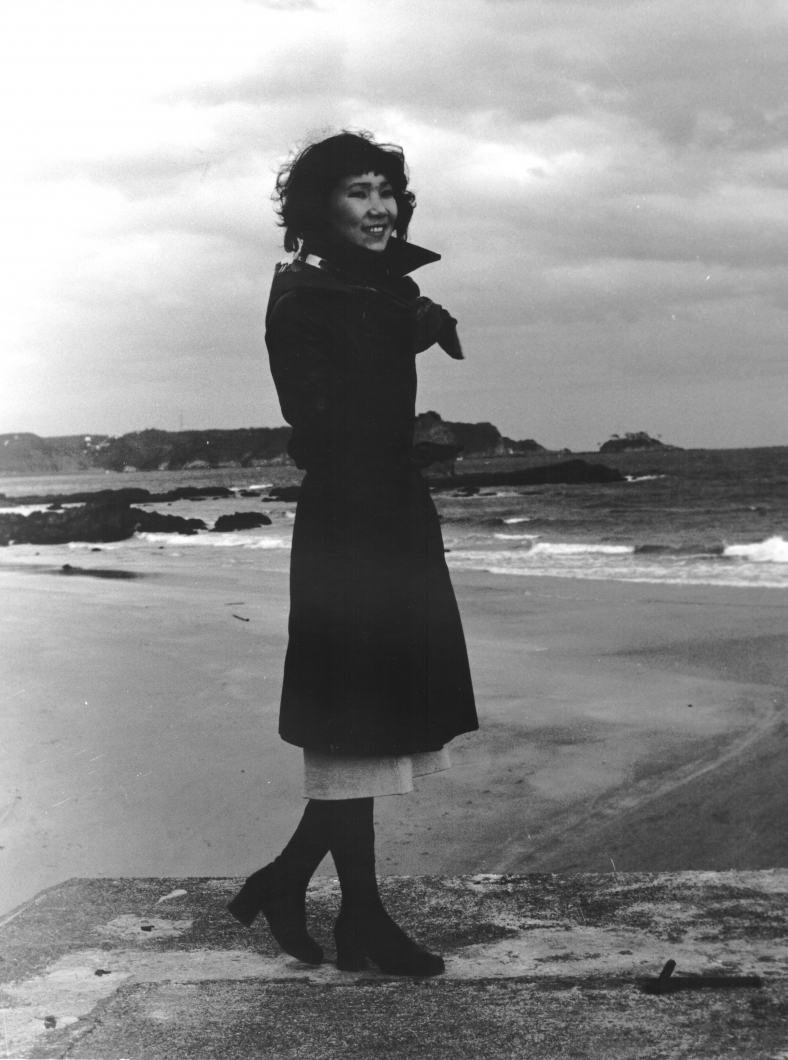
Shimoda, early January 1975
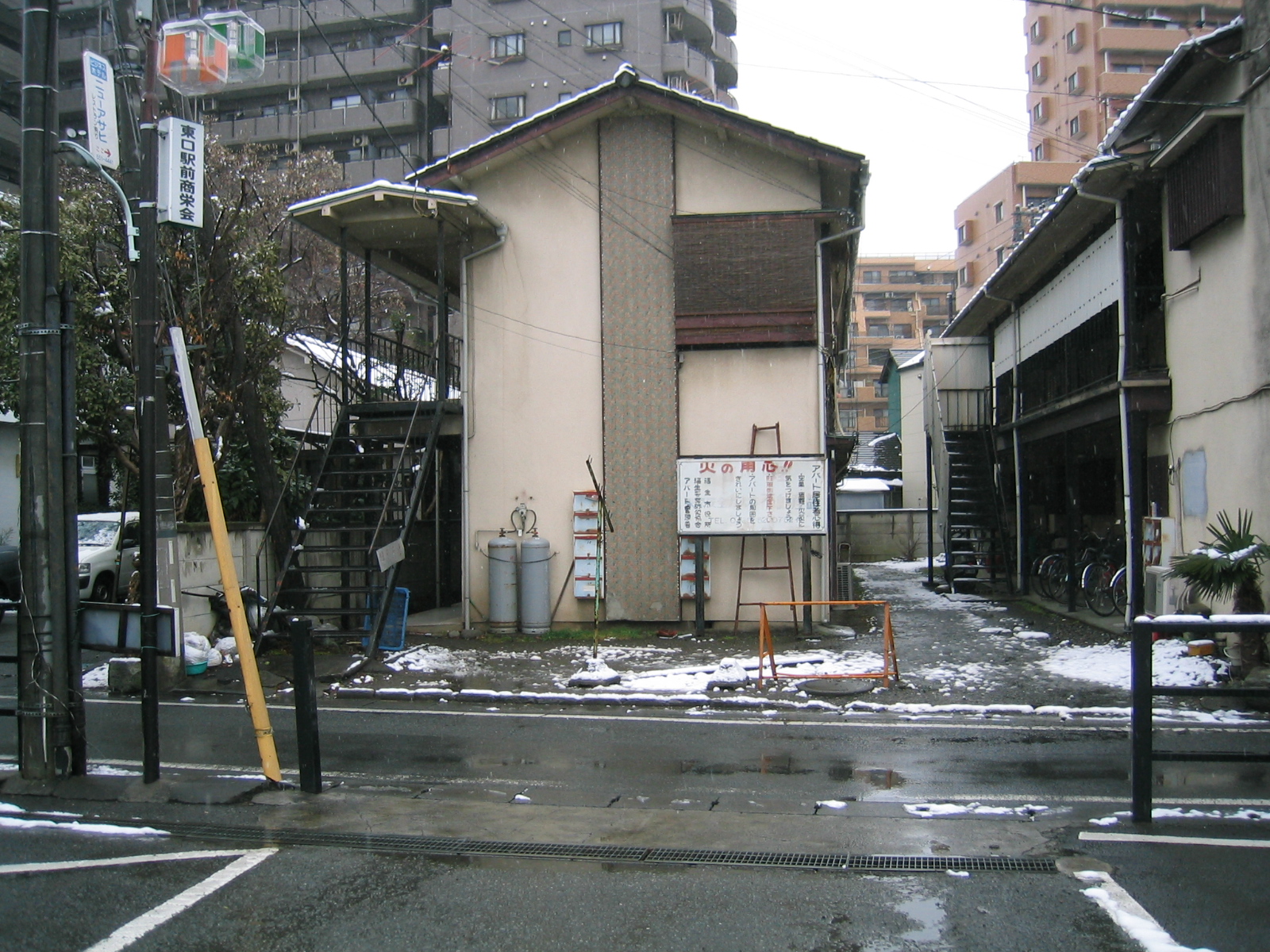
Our first apartment was in this building (2005 photo)
Inside our first apartment, sharing space under the kotatsu
She thought about it for a minute, and then replied that she didn't think that either of us actually proposed. Furthermore, she deduced that we must have just mutually assumed that we were to get married, and therefore proceeded as such. I think that she is right, so with that being the case, I would have to classify our getting married as being a change in our lives that was most certainly "natural and spontaneous".
Ritsuko and I had known each other for about two months when, in early January 1975 after we had returned from spending a few days together in Shimoda, we decided to live together. She had been working at the Ginza Mitsukoshi department store, and was living in a small apartment in Shinagawa-ku, both situations that could be cancelled on short notice. I was living in one of the 610 MASS enlisted barracks at Yokota Air Base. Neither of us had many possessions, so after we found an affordable (about ¥18,000/mo, which at the time equated to $60US) apartment near Fussa Station, it was a fairly simple matter to move our belongings to our new digs, and to set up housekeeping as a couple.
The apartment was a walk up cold water flat on the second floor of an older building of similar units, located about 3 blocks from the east entrance of the station. It was a tiny flat consisting of a single 6 tatami mat room (approximately 100 sq ft) for living and sleeping, a toilet (fortunately, it was a western style flushing type), and a minuscule kitchen. The kitchen was nothing more than a narrow space with a linoleum floor and a stainless steel counter with a sink and a sunken space with a gas spigot to which one could attach two propane burners. At the end of the counter, next to the wall, was a small space for a mini refrigerator. One of the two windows in the flat was above the kitchen sink, providing us with a view of the second floor walkway adjacent to our unit. The other window was in the main room, giving us a view of the neighboring apartment building, and if we leaned out of the window we could see the street below. There was no bath room, therefore in order to bathe, every night we would walk a block down the street to the neighborhood Sentō (public bath house).
Fitting out our new abode, we needed to acquire a few things. A friend of mine loaned us a gas space heater and a mini fridge. Ritsuko and I both already owned futons, some blankets and pillows, and a few plates and drinking glasses. Ritsuko had a few cooking utensils, and a small cabinet for storing them. Our first day in the apartment, I went to the Fussa Seiyu department store, which was conveniently located two blocks away, and bought a few more kitchen items, a couple of propane burners, some gas hose, and an electric kotatsu, complete with an insulating pad to protect the tatami and a comforter to fit between the kotatsu base and table top. We were pretty much set, and then as we discovered that we needed something else, a trip to Seiyu was only a 5 minute walk.
With our relationship having become more serious, there was one pressing issue that weighed heavily on us both. My DEROS was June 13, 1975, and although I didn't yet have PCS orders, I had informally been told that my next assignment would be at Hanscom Field, near Bedford MA, where I was to be a member of a joint project of the US Air Force and NOAA. My role in the project would be supporting specialized airborne weather data gathering equipment installed on two NOAA C-130 aircraft. As a single airman, I had thought that it would be a great assignment, and had ardently campaigned to get it. However now that my relationship with Ritsuko had grown more serious, I had to rethink and re-prioritize my career objectives. I thought that a June 1975 DEROS would put us under too much pressure. I knew that it would take at least a couple of months to get permission to marry, and then we would have to rush into a move halfway around the world. I would be taking Ritsuko into an unknown environment where she would likely have to fend for herself since my new job would frequently require lengthy TDY's to the far corners of the world. That would surely place a lot of strain on any relationship, but with us being newly wed, I thought that it would likely be too much to endure. I couldn't say definitively that our marriage wouldn't have worked out if we had to leave Japan that year, but we both thought that if I could extend my tour in Japan we would be in a more stable environment, and our relationship/marriage would have a much better chance for success. It was a good thing that I didn't yet have official orders; that made an extension request less problematic. On January 13th, I initiated a request to extend my tour in Japan for one year; fortunately it was quickly approved.
Ritsuko spent many hours completing the USFJ Form 196EJ.
So, as we went about our daily lives, living together in the tiny apartment, the specter of having to hastily shuffle off to my next assignment was no longer weighing on our minds. We could just focus on having fun and experiencing the joy being with each other as a vision for having a future together became more of a reality.
I have no idea what bureaucratic hurdles US military personnel currently serving in Japan must encounter when marrying a Japanese citizen, but it is probably no easier than it was in 1975. I had to meet with my squadron commander and first sergeant to get their approval, Ritsuko and I each had to be interviewed by an Air Force attorney, and she had to undergo a pre-marital physical examination by an Air Force physician. However, the most arduous, tedious, and time consuming task was that Ritsuko had to complete the hideously detailed USFJ Form 196EJ, a six page document via which she was to list her personal history, in Japanese and English. It was required to be submitted in 6 copies (all original; no photocopies allowed) as part of the package of official documents that we had to submit in order for us to receive permission from the US Air Force to marry. Once all that was completed and submitted for approval, all we could do was wait.
While we waited, we really had a lot of fun just enjoying the simple pleasures of being together. It was winter time, and the nights were cold, but it was always warm inside our little apartment. In the evening, we would often sit at the kotatsu, either reading or playing card or board games whlle listening to corny old radio shows like Gunsmoke or Chicken Man on F.E.N. Tokyo. Almost every night, we would hear from the street below, the sweet potato man calling "YAAAAKI IMO, YAKIIMO!!" as he pushed his cart with a charcoal oven full of delicious baked sweet potatoes. As soon as we heard him, Ritsuko and I would immediately do a quick jan ken pon (rock paper scissors) to determine who (as I recall it was usually me, in that I almost always lost the game) would rush out into the cold night to buy two freshly baked delicious sweet potatoes wrapped in newspaper. Simple times, simple pleasures, these are memories that we have cherished ever since.
On a Friday morning in early April, I went to the base in order to use the laundry facilities at the barracks, where, being single, I was still officially a resident. I had been on leave for the past few days, and my list of things to do on base also included checking into the squadron orderly room to see if my marriage approval request had been processed. And, happy days, there it was ... the long awaited "Permission to Marry" paperwork. When I returned to the apartment, Ritsuko was having her morning coffee. I flashed the cover letter at her, and said, "it's approved! we can get married today if you want to."
"Sure, why not", she replied with an eager smile that belied the nonchalant tone of her answer. So, after a quick change of clothes, and a walk to Fussa Station, we were on our way to the Consulate office at the US Embassy in Tokyo. I had been there before to serve as a witness for some friends who had gotten married the year before, so I kind of knew the drill. We didn't take anyone with us to witness, but I wasn't worried about it. There were a lot of American citizens in Tokyo, and every day, people came into the Consulate office for a variety of reasons. I was certain that we could talk someone into taking a few minutes to witness our marriage.
At the Consulate office, we had only a short wait until we were at the counter to begin the marriage process. I gave the Consular official our paper work, and when asked about our witnesses, I ask for a few minutes to fetch them. About that time, a middle aged couple came through the door. I introduced myself to them, explained why I was there, and told them that I realize that my request is rather unconventional, but asked if they would be so kind as to take a few minutes that afternoon to witness a marriage between Ritsuko and me. As I spoke, I saw the look of skepticism, bordering on "this young man must be insane", on their faces slowly warm into smiles as they agreed to help us.
So, we were then able to complete the first part of the process. With that being done, we said goodbye to the kind couple, and proceeded to the Minato-ku ward office so that our marriage could be registered with the Japanese government. Afterward, we returned to the US Consulate office to show proof that the marriage was properly registered. At that point, in accordance with the laws of both Japan and the United States, Ritsuko and I were officially married.
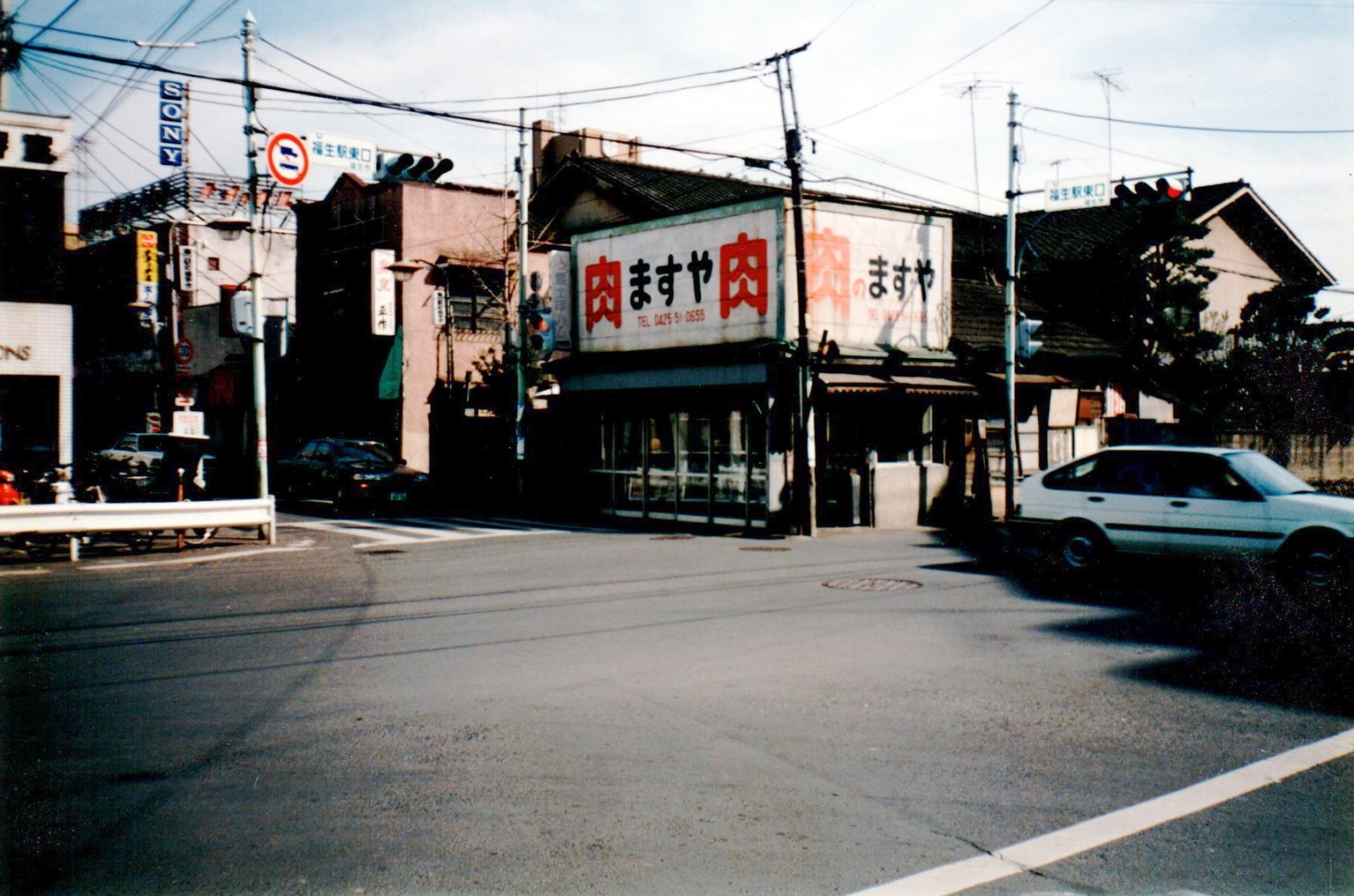
meat market near our apartment (1991 photo)
Condensed into a few short paragraphs, the events of the day seem pretty simple and straight forward, but it was really an exhausting day. It was late evening when we finally returned to Fussa, and having been caught up in the intensity of the moment, we had not eaten since morning. We were both tired and hungry, and neither of us wanted to go to out for dinner. Fortunately, the meat market between the station and our apartment, that made the absolute best fried chicken and korokke was still open. We bought a couple of fried chicken breasts and korokke, went home and celebrated our marriage with a meal of fried chicken, korokke, and milk, which was the only drink other than water that we had in our apartment that day.
Earlier this year (2022), Ritsuko and I celebrated our 47th anniversary; on every one of our anniversaries, we have commemorated the day with a celebratory meal of fried chicken and milk.
Ritsuko's family all lived in either Kagoshima Prefecture or Osaka; my family was in Texas. We did all this in secret, knowing that some of them might be upset, but our thought was that the marriage was between the two of us, and the two of us only, and we really didn't want any advice or help from anyone else. Now that we were actually married, we decided that this was the time let everyone know. Knowing that this could have been a shock to our parents, I would have to say that actually, it all went pretty well. Ritsuko and I were both 25 years old at the time, and by then, her parents and mine were well aware of how head strong stubborn their children were; thus no one voiced objection.
Ritsuko and I realize that to many of you who are reading this story of our rather unconventional marriage, it all probably sounds crazy, strange, and funny. Well, I get it, because so many years later, we still laugh about it too.
The next Monday, I had a few administrative details to take care of. I went to my squadron orderly room, and started the paperwork to convert my overseas tour to command sponsorship. This would allow Ritsuko, who was now in the eyes of the military, my dependent, to enjoy the full benefits of an overseas military spouse for the remainder of my tour in Japan. Also, I applied for housing allowance, and basic subsistence allowance. Finally, I had to submit a request for Ritsuko to become eligible for a non-quota immigrant visa when we finally did depart Japan.
That all went pretty smoothly. There were no hangups in the process; command sponsorship was granted, I received a cash payment for April housing and subsistence allowance, and the Consulate was notified of our intent for Ritsuko to eventually apply for a non-quota immigrant visa. At the Base Housing Office, I got on the waiting list for base housing. Being a Staff Sergeant with no children, we qualified for a small two bedroom unit. At the time, there were MANY people on the small 2BR list; two were at the rank of Staff Sergeant (E5), and everyone else were Sergeants (E4). Since the base housing list priority was rank then time on list, this meant that we were number 3. The housing office told me at that time that the two ahead of me would get housing in May, and that unless someone of higher rank moved onto the list, we would have first pick in June. A three striper (sergeant) friend of mine had been on the list for almost a year, and yes, he did express his displeasure that I jumped to the top of the same list that he had been on for months, but "hey", I told him, "it's the military, and that's how it works".
The short wait for base housing was the good news. The not so good news was that we couldn't stay in our apartment. It was not on the "approved housing list". So, on the advice of the Base Housing Office, we rented a house in Fussa's Sun Heights that was on the list. I don't think that Sun Heights exists today. It was a cluster of small wood frame stucco clad western style houses across Highway 16 from the Yokota Air Base main gate. Where our house stood back then is now a parking lot behind an Italian restaurant.
Although we would have been content to remain in the tiny apartment until we moved into base housing, and moving into a different home for only a month seemed excessively tedious, it was nice to have the living space and convenience of a house, and being able to take a bath or a shower in our own house was definitely a welcome change. The house was a simple single floor structure with two bedrooms, a living dining kitchen area, and a bathroom, and it was equipped with what we used to call a "Fussa Skyrocket" kerosene fired water heater. The name was suggestive of what would allegedly happen if one left it unattended while heating water because the burner was not thermostatically controlled. In other words, when we needed hot water, we turned on the kerosene, lit the burner, waited until the water was sufficiently heated, then turned off the kerosene flow. I don't know if any of these contraptions ever actually took flight or exploded, but I am pretty sure that a pipe or relief valve would have blown and made an awful mess. We treated our skyrocket with due respect, and never attempted to find out if the nickname was justified.
Moving into the Sun Heights house, Ritsuko and I were both really surprised and thoroughly impressed with the level of service that the Yokota Base Housing Office provided. On the day we moved in, a truck arrived at the house, and in short order, a team of workers unloaded and set up a complete set of furniture in all rooms, and they installed the kitchen stove and refrigerator. A month later, on the day that we moved out, a crew showed up to dismantle and carry everything away, as another crew was setting up a different set of furniture in our base housing unit. I would sometimes hear people complain about the housing office, but the whole time that we stayed at Yokota, the level of service that we received from them was superb.
Ritsuko loves animals, especially cats. I knew that from the stories that she told me of when she was a little girl, how she would hide the family's two cats inside her futon on cold winter nights so that she would have two warm, furry yutanpo. Of course, her younger sister would inevitably call foul, and demand that she share. Ritsuko will dig in her heels and fight for something that she really wants, but so does her younger sister. I can only imagine how intense these childhood disagreements must have been. But, their mother was a noble lady with great wisdom and intelligence, so I have no doubt that ultimately some agreement was reached.
I was not a cat person. It wasn't that I disliked cats, I just had never been really close to one. Honestly, in my lifetime to that point, the only cat with whom I had any kind of a relationship was that when I was very young, a neighbor's cat would sometimes use my sandbox as a toilet. Certainly, at the time I was very upset with the offending feline, but then later on, in my teen years, I began to realize that the cat had actually been teaching me a very valuable lesson about life. For the act of the cat defecating in my sandbox was merely a metaphor for the fact that regardless of who you are or who you become, there will always someone out there who believes that they are entitled to use your sandbox as a toilet, so in order to maintain one's sanity it would be wise to learn to see such a thing coming and to be prepared to deal with it.
We had only been in Sun Heights for a few days when Ritsuko learned that a neighbor's cat had recently given birth to a litter of kittens, and she announced to me that she had been promised one. Getting a cat, or any other kind of pet was not something that I had even considered before she told me about the nearby kitten. However, knowing that it is inevitable that from time to time, I will unintentionally, innocently, and unknowingly do something that will upset my new wife, I determined that this should not be one of those times, and that it would be a foolish mistake for me to protest the matter. I just shrugged, "OK".
My memorable trip to Guam, May 1975
A few days later, in mid May 1975, I was assigned to go TDY to Andersen AFB, Guam for a week or so in order to attend a class. It was an interesting TDY ... not the class, that was just some technical training. What made the trip interesting was being able to visit with Alan, Charley, and Frank, some old friends with whom I had worked when I was in the 55th Weather Reconnaissance Squadron at McClellan AFB, and that I had the opportunity to witness first hand an historical event.
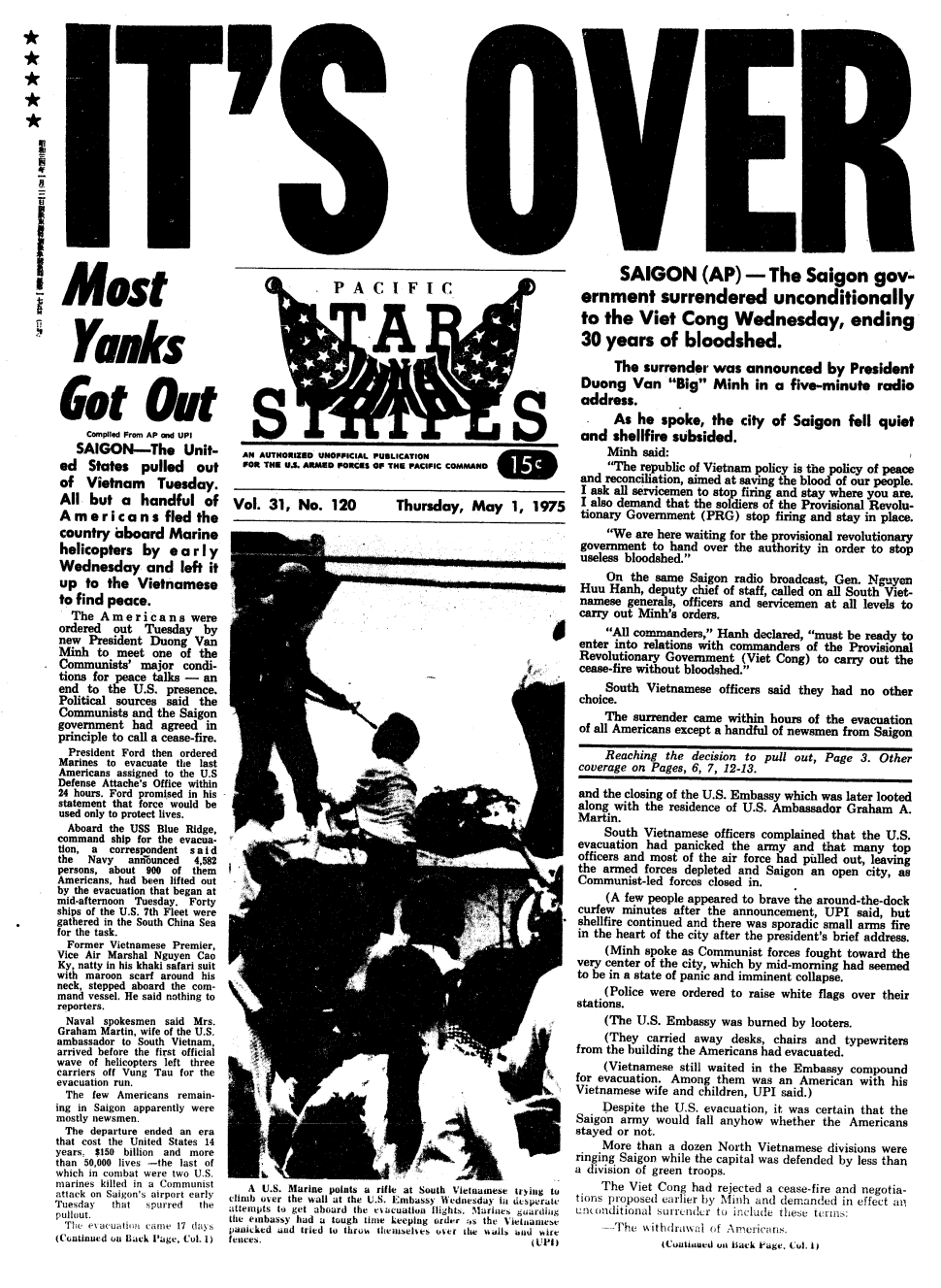
May 1, 1975: Pacific Stars and Stripes front page announcing the end of Vietnam War
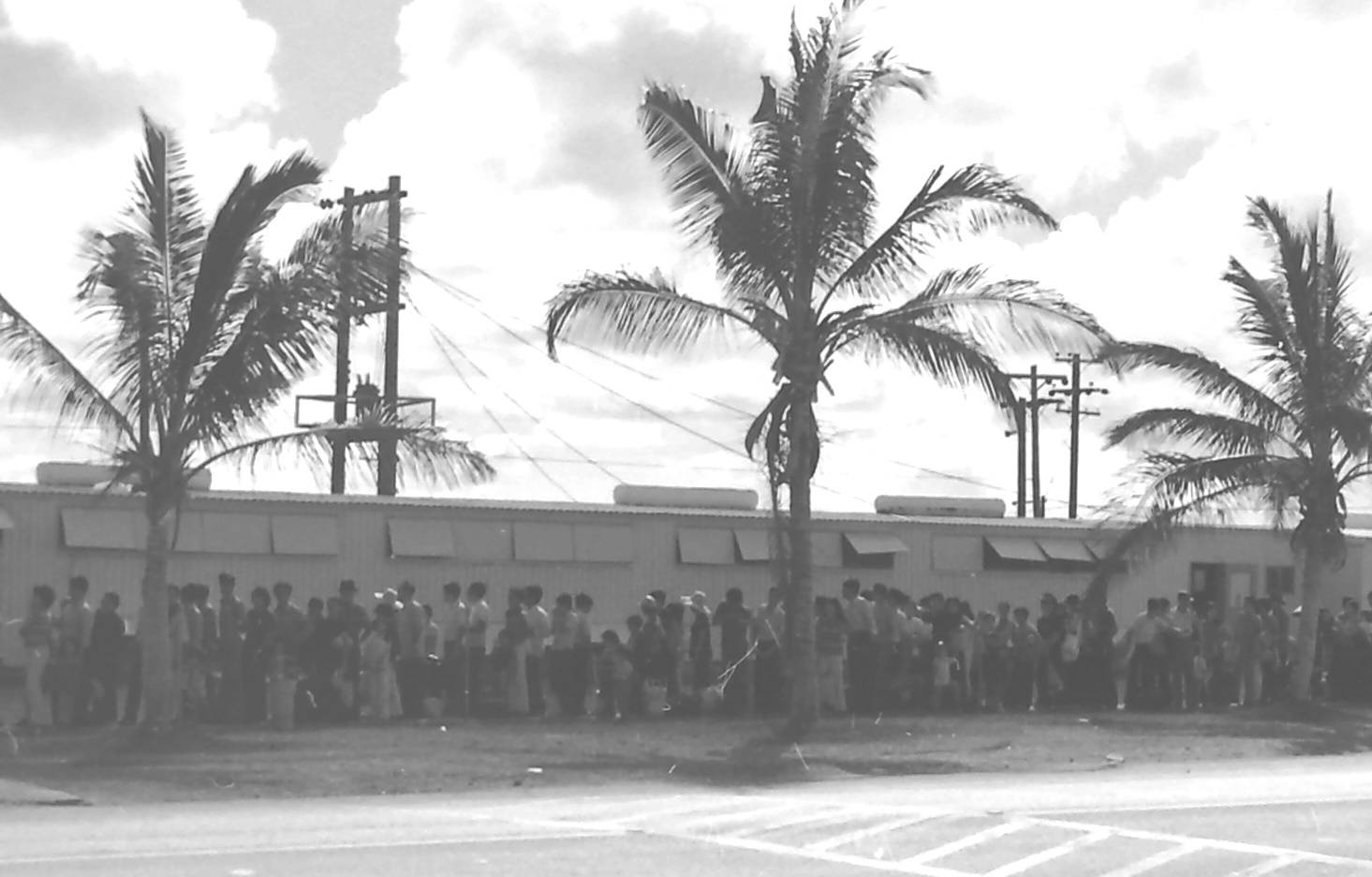
Vietnam refugee relocation processing center, Andersen AFB Guam May 1975
Every day when walking from the transient quarters to the flightline hangar where my class was held, I walked past a large facility that was being used as a refugee relocation center. The city of Saigon had fallen to the army of North Vietnam just two weeks earlier, on April 30, 1975, thus bringing the Vietnam War to an end. In the final days thousands of people were evacuated from Vietnam, and the evacuees, as a step in their journey of being relocated to the U.S., had been taken to one of several relocation centers that had been established in the Pacific region, one of which was at Andersen Air Force Base, Guam.
In my early teen years, I had bought into the justification for U.S. involvement in Vietnam; yeah, you know ... domino theory, commie behind every tree, the whole thing, hook/line/sinker. Early in my sophomore year in college, at the age of 19, I really began to question that justification. Choosing to ignore the loud voices on both sides of the issue, I took it upon myself to spend many late nights in the university library independently studying the history of Southeast Asia, thus gaining a broader insight into the background and complexities of the conflict. As a result, my attitude evolved into one of thinking that U.S. foreign policy in the region was, to say the least, misguided. But, misguided or not, the war went on, many people on both sides died, and now it was finally over. The war had come to an end, and I was among the many who were glad for that. I was also happy to see that after such a fiasco of foreign policy, the American government, the military, and the American people were now putting forth such an extraordinary effort to help the people who were escaping the aftermath of the war.
Sometimes, as I walked past the facility, I would walk close enough to the fence that surrounded the compound that I could see the faces of the people standing in line. I could not even begin to imagine what these people were thinking and feeling, having faced the terror of a hostile force taking over their home, and being forced to gather what few belongings they could carry before joining the frantic crowds of people fighting for a place on any of the airplanes or helicopters leaving the country. In the crowd, there were people of all ages. No doubt, some were able to escape with their families, but many of the refugees had to leave family members behind, knowing that the conquering force would look upon those left behind who had supported the South Vietnamese government as miscreants who needed to be punished or "re-educated", and living with the fear that they would probably never be able to see their loved ones again.
In contrast to the look of fear, despair, and uncertainty on the faces of the adults, many of the young children seemed to be adapting well to their temporary accommodations on Guam as they laughed and played together. Some of them watched the airplanes landing and taking off from the nearby runway, folding and flying paper airplanes to imitate the big jets flying nearby.
The sights, sounds, and emotions of this experience have remained with me as vivid memories, and I always have held a deep respect for immigrants who have come to our country and make a new life for themselves and their families. In doing so, they have contributed greatly to the economic and cultural growth of the United States.
Twenty five years after my visit to Guam, I was employed by a company where one of my co-workers was a young woman who was born in Vietnam, and who had immigrated to the U.S. with her family when she was 5 years old. Her father had been a South Vietnamese government official, so hers was one of the families who had fled at the end of the war. One day during a coffee break, she and I were sitting alone in the company break room when she began to talk about her parents, her siblings, some memories she had of her homeland, and some of the challenges that they endured in their relocation to the U.S. Then I shared with her my memories of being on Guam, and seeing the people in the relocation center every day. As I spoke, she stared at me, her eyes growing wider with each word as I described what I had seen.
When I paused after describing the children and their fascination with airplanes, she said, "We were on Guam". Then, as my mouth began to drop open, she added with a big smile, "and I played with paper airplanes."
After that, there was nothing more to say. We sat in silence for several minutes, until it was time to get back to work.
The revelation that this intelligent, articulate, university educated young woman was perhaps one of the children whom I had seen playing on the other side of a refugee camp fence halfway around the world 25 years earlier, confirmed just how small the world actually is, and that given the opportunity and freedom to grow there is no limit to what people can achieve.
Back home to Ritsuko and the cat
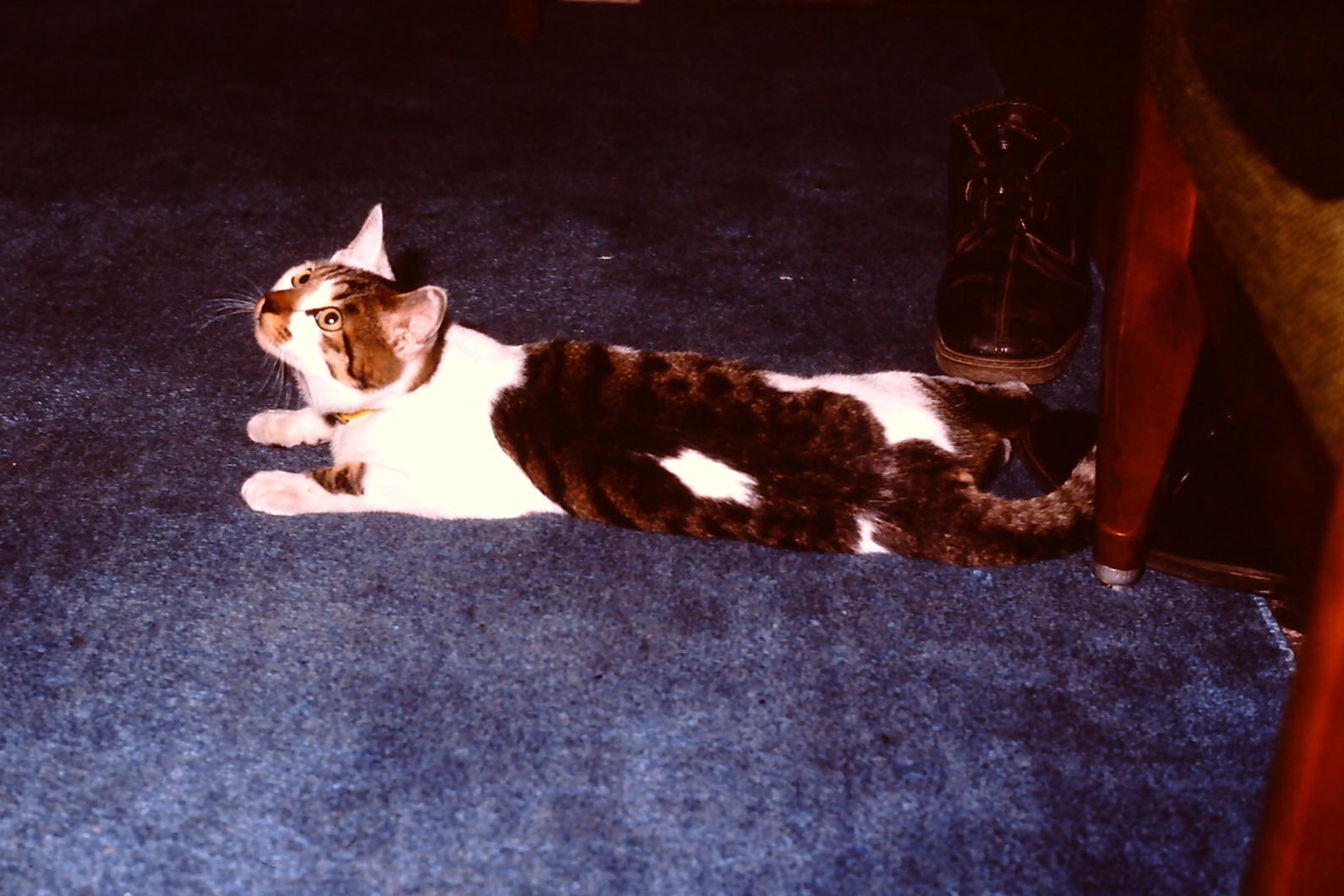
When I returned home, I learned that we had a new addition to our young family -- a kitten. Ritsuko held the little fellow up to me and said, "see the circle on his back; it looks like a donut, so his name is Donuts. Isn't he cute? Here, hold him".
Donuts showing the namesake pattern on his back.
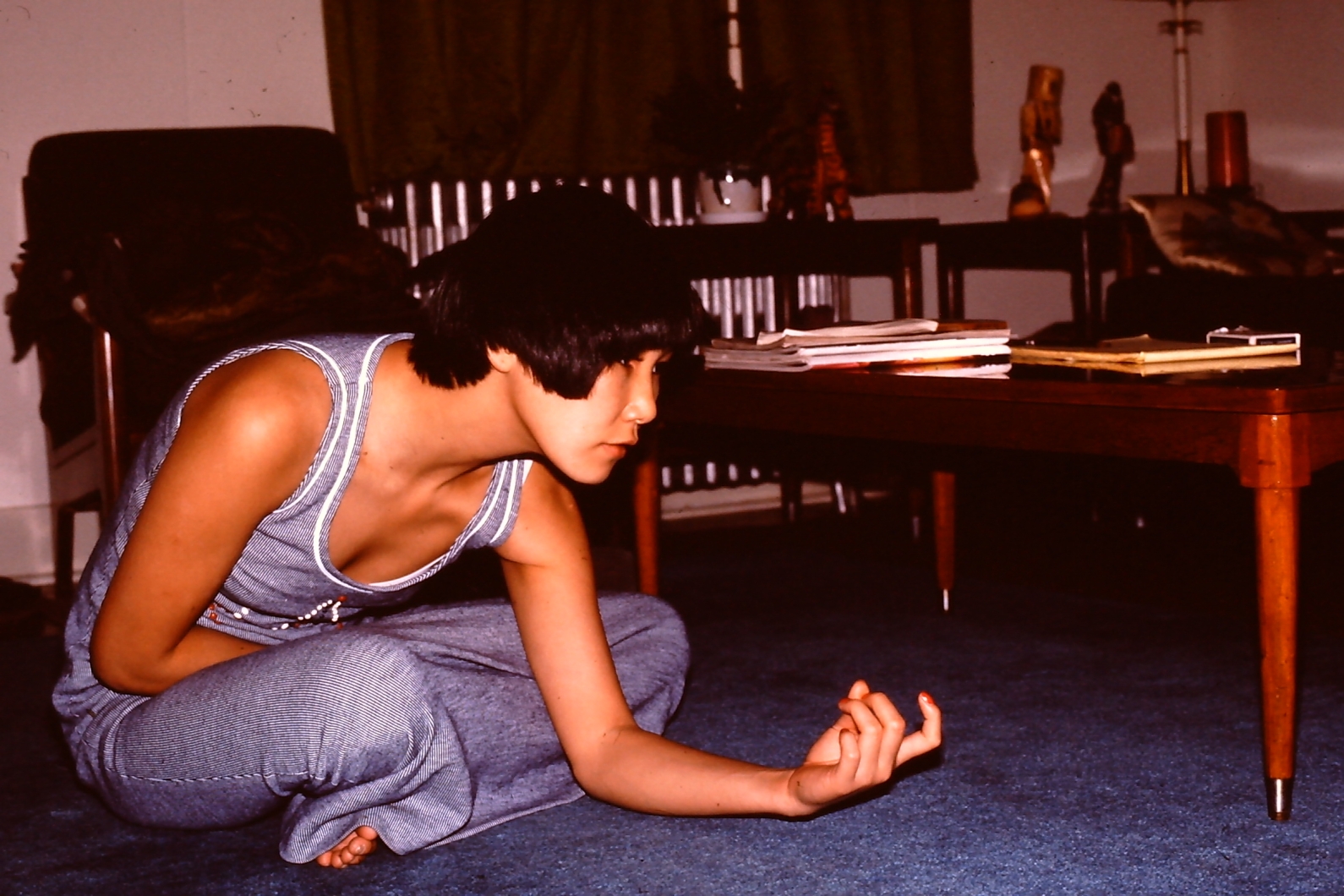
Ritsuko attempts to coax Donuts to come out from under the sofa.
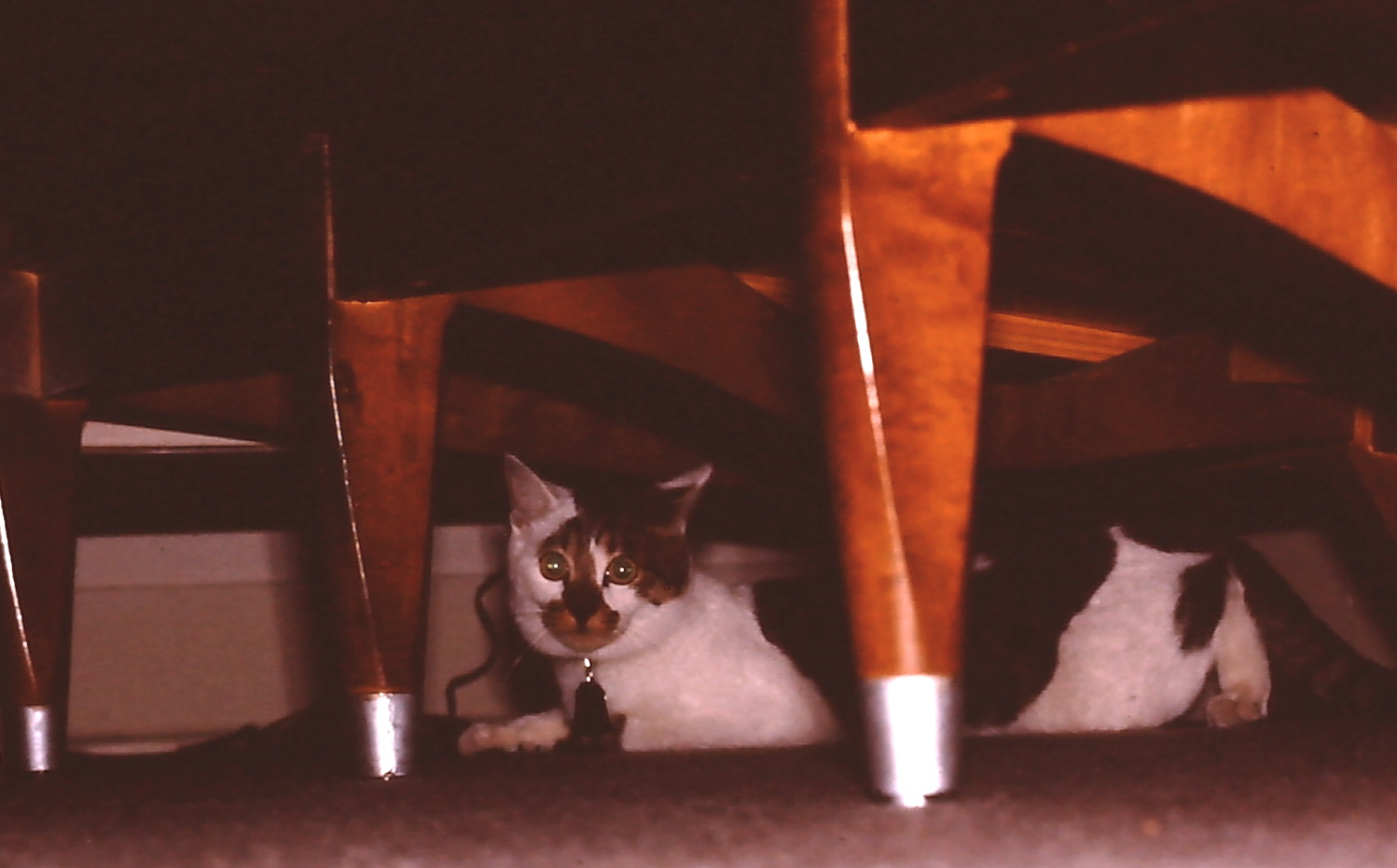
Not just yet Mom; I kindof like it under here.
She handed the cute little ball of fur to me, and as I held him, he rubbed his head against me and purred. At that moment in time, I was instantly and forever transformed into a cat person.
I was impressed by the fact that when Ritsuko set up a litter box for him, he knew what to do from then on. Yes, now I like cats even more. I wasn't too happy at first when he jumped into the bed with us, but I soon got used to it. It was easier to give in to letting him sleep on our bed than it was to listen to him cry, and afterall, he was still a baby who missed his mother and siblings.
Donuts was a very happy boy. He was close to both of us, but it was pretty obvious that he chose Ritsuko to be his surrogate mom. It was fun to watch the two of them together. Ritsuko would tell him to do things, like jump into the laundry basket, and he would do it. In our base housing unit, our washing machine was in the kitchen, and Ritsuko would often set eggs on top of the machine while she cooked breakfast. Donuts, upon seeing that would jump onto the washer, knock one of them off onto the floor, and then stare at Ritsuko as if waiting for instructions. "Donuts!! Clean up your mess!" she would command. Donuts would then jump down to the floor, and proceed to eat the broken egg, licking the floor until it was clean.
After we moved to base housing, by the time that he became an adult, the northwest corner of the West Housing Area had become Donuts' domain. As a kitten, he had once been chased up a tree by a neighbor's dog, but by the time Donuts had reached adulthood, he was a very powerful tomcat, and one day, that same dog tried to attack Donuts, but after a few lightning quick swats to his nose, learned the hard way that is best to just leave Donuts alone.
Donuts could be very fierce, but he was also a compassionate gentleman. A scrawny little female feral cat that often prowled the neighborhood became Donuts' girlfriend. One of our neighbors told us that she saw Donuts meeting his girlfriend at the perimeter fence, and presenting her with a freshly killed bird. We then started leaving food outside on the front porch, which Donuts would share with her. He was such a sweet boy.
He was our first cat, and neither of us really knew much about how to keep a cat in what amounted to an urban environment. We had been advised to have him neutered at the age of about 3 months, but we thought that was too cruel, and therefore let him stay intact. The result of that was that he not only grew into a lean, muscular hunting machine, but also at about a year and a half, he began to mark his territory, which was everywhere, therefore he began to spray everywhere. One day, as I was putting on my boots to go to work, he decided to mark me as one of his belongings. Ewww! change of clothes, and those fatigues went right into the washing machine. We then decided that we must do something.
The situation was definitely untenable. We could have had him neutered at that time, but he was already well accustomed to using all the equipment that nature gave him, and it just didn't seem right to take it away. Besides that, I learned that if an adult cat has started spraying, he will most likely continue to spray even if he is neutered, so in addition to it being cruel, there was no point by then of getting him "fixed".
As difficult as it was to do so, we decided that the best thing to do was to find a new home for Donuts. Ritsuko had grown up in an area that was mostly rural, and knew that farmers would be happy to have a strong hunter like Donuts, so one evening, in early 1977, we drove to a rural area in nearby Saitama Prefecture, and gave our Donuts to a farm family, never to see him again. We both cried as we drove home that night.
I hope that Donuts had a long and happy life. It wasn't until mid 1979, about a year after I had separated from the Air Force, and also about the time that we were buying our first house, that we got another cat. By that time, we had learned more about how to be properly responsible cat parents. Since then, there has always been at least one cat in our family.
We move into Base Housing - The holy grail of accommodations
Perhaps, given the absence of luxury in 1975 Yokota Air Base Military Family Housing, idiomatic use of the term "holy grail" might seem like an overstatement, but in the context of our options at the time, this was, in my opinion, the ultimate.
Moving on base from our off base rental, we had a few options.
One of our options was to apply for housing at nearby Tachikawa Air Base, which was in the process of being turned over to the Japanese government. A lot of people preferred living at Tachikawa, but we thought that Yokota would be more convenient in that this was where I worked, and because it was just a matter of time before all U.S. personnel living at Tachikawa would have to move. Also, plans were in place to upgrade many of the facilities at Yokota, therefore in the coming years, it was destined to become an even better place to be stationed.
Moving onto Yokota, we had two options, traditional base housing or "lot house". The lot house was a rather interesting concept. I had known several people who had lot houses at Yokota and Tachikawa, who were quite happy with the arrangement. I don't remember all of the fine print details of the lot house arrangement, but from what I can recall, the military member purchased the house (the ones that I knew of had been purchased for less than $1000), then he or she was responsible for paying for all utilities and maintenance. Of course, the main attraction to this type of arrangement was that the member continued to receive their housing allowance, therefore, even though the cost of electricity, propane, and heating oil could be pretty steep, it was possible to make money by spending less than what they received in their housing allowance.
Our base housing apartment was an end unit of Bldg 3100, a fourplex of small 2BR units in the Yokota AB West Housing area
Ritsuko hosting a party in our base housing quarters, circa 1977
In traditional base housing, one would relinquish their housing allowance upon moving in. However, all utilities, including electricity (install and run window AC units in the summer - no problem), hot water that was piped in from the base hot water plant (long showers and loads of laundry - the water would still be hot), steam heating (yeah man! it was toasty warm), and garbage pickup were included. Also, if there was a problem with wiring, plumbing, heating, appliances, etc, one would just call the housing office, and the problem would be quickly taken care of. All we had to do was to keep the place clean, not junk it up, and keep the lawn mowed. Sounds like a great deal to me!
There were four military family housing areas at Yokota Air Base, North, South, East, and West. The North Area, on the main part of the base, nearest headquarters and the terminal was for officers. Enlisted personnel resided in the other three areas. The South Area was also on the main part of the base. The East Area was across the base on the east side of the runway. It was being developed with newer housing units, like the garden apartments and the first of Yokota's high rise buildings. The apartments were new and well equipped, but at that time the smallest unit was a 3 bedroom, and since we didn't have children, we didn't qualify. Aside from that, I really didn't want to live on that side of the base. The West Area was actually my first choice. Although slated for future re-development with newer housing units, the housing of that time consisted of older frame/stucco units. It was detached from the main base, being on the west side of Highway 16, with the main gate directly across from the passenger terminal gate. Access to the West Area back then was unrestricted, so our friends from off-base could visit easily. Also there were unlocked pedestrian gates on the back fence, providing easy access to Fussa by foot or bicycle.
So, the first of June 1975, Ritsuko and I said goodbye to Sun Heights, packed our belongings and Donuts the kitten into our car, and drove to unit 3100-A, Yokota Air Base West Housing Area. Building 3100, a fourplex of small two bedroom units, was a two story, wood frame, stucco building near the perimeter fence in the northwest part of the West Housing Area. Our unit, "A", was an end unit, thus we had windows on 3 sides of the apartment, and we had neighbors on only one side. On the lower floor, was the living room, dining room, and kitchen. Upstairs, there were two bedrooms and the bathroom. One bedroom was large with four windows, two on two sides, and a good sized closet. The other bedroom, tucked away in a corner of the second floor, was smaller, but still large enough to adequately serve as a guest room.
One window in the living room and one window in the larger bedroom were already set up for window air conditioners. Below the living room window was a 200V outlet, and below the bedroom window was a dedicated 100V outlet. I had already been to the unit to check out the potential AC situation, and had bought two air conditioners (one 200V and one 100V) from a retired USAF Master Sergeant who lived in Fussa and had a side business reconditioning and selling used air conditioners. The days were getting hotter, and more humid. Soon the rainy season would start, and we were glad to have air conditioning that would keep the inside air cool and dry.
Base housing provided a full set of furniture for every room, which a housing office crew brought to our new quarters, and set up for us. Since we had no furniture at all, that was a much appreciated benefit. The unit itself already had the appliances installed, including a refrigerator, 4 burner electric range with oven and broiler, washing machine, and clothes dryer. The washer was installed in the kitchen, and the dryer was in the dining room. Odd placement perhaps, but we didn't care where the washer and dryer were installed as long as they were in our quarters!
Having our own washer and dryer were definitely a luxury for us. In our Sun Heights house, Ritsuko would often wash clothes in the bathtub. One day during our stay in Sun Heights, driving home from work, as I approached the house, I noticed that the bathroom window was open, and I could see Ritsuko moving quickly back and forth as if she was jogging in place in the bath tub. She hadn't noticed that I had parked the car and was walking up to the window. Seeing what she was doing, my sudden burst of laughter startled her, and I said, "don't mind me, Lucy, please carry on!" She quickly got over her shock, and also began to laugh as she made the connection of my "Lucy" reference. Reminiscent of an episode of "I Love Lucy" in which Lucy was stomping grapes in an Italian winery, Ritsuko had pulled up her skirt, tucking it into her waist line, and was stomping the laundry in the bath tub, "Lucy style". Ingenious and funny as that was, it was still a lot of work, and I am pretty sure that she had no desire to do it again.
We were only in the sixth month of 1975, and so far it had definitely been a year of changes for Ritsuko and me. Now, going into our first summer together, we were married, we had a cat, and we were the new occupants of 3100-A, Yokota West Area. We didn't know at the time, but I would eventually extend my tour in Japan for two more years, and this was to be our home for the next 3 years.
Ritsuko finds employment
Soon after we moved into our new quarters, Ritsuko and I were talking about what she would like to do now that we were in a more settled situation. Knowing Ritsuko's background, and having been in and around Fussa for two years, I had an idea that I thought might be the perfect opportunity for her.
Ritsuko had a rather interesting work history. She graduated from high school in Okuchi, a small city in Kagoshima Prefecture that was about 45 minutes by train from her home town. That school specialized in teaching students the basic skills that they would need in order to work in a variety of businesses, and employment scouts from several large companies would review the graduates each year, looking for potential employees. In 1968, when she graduated, Ritsuko was recruited by Seiyu Department Stores to work in Tokyo.
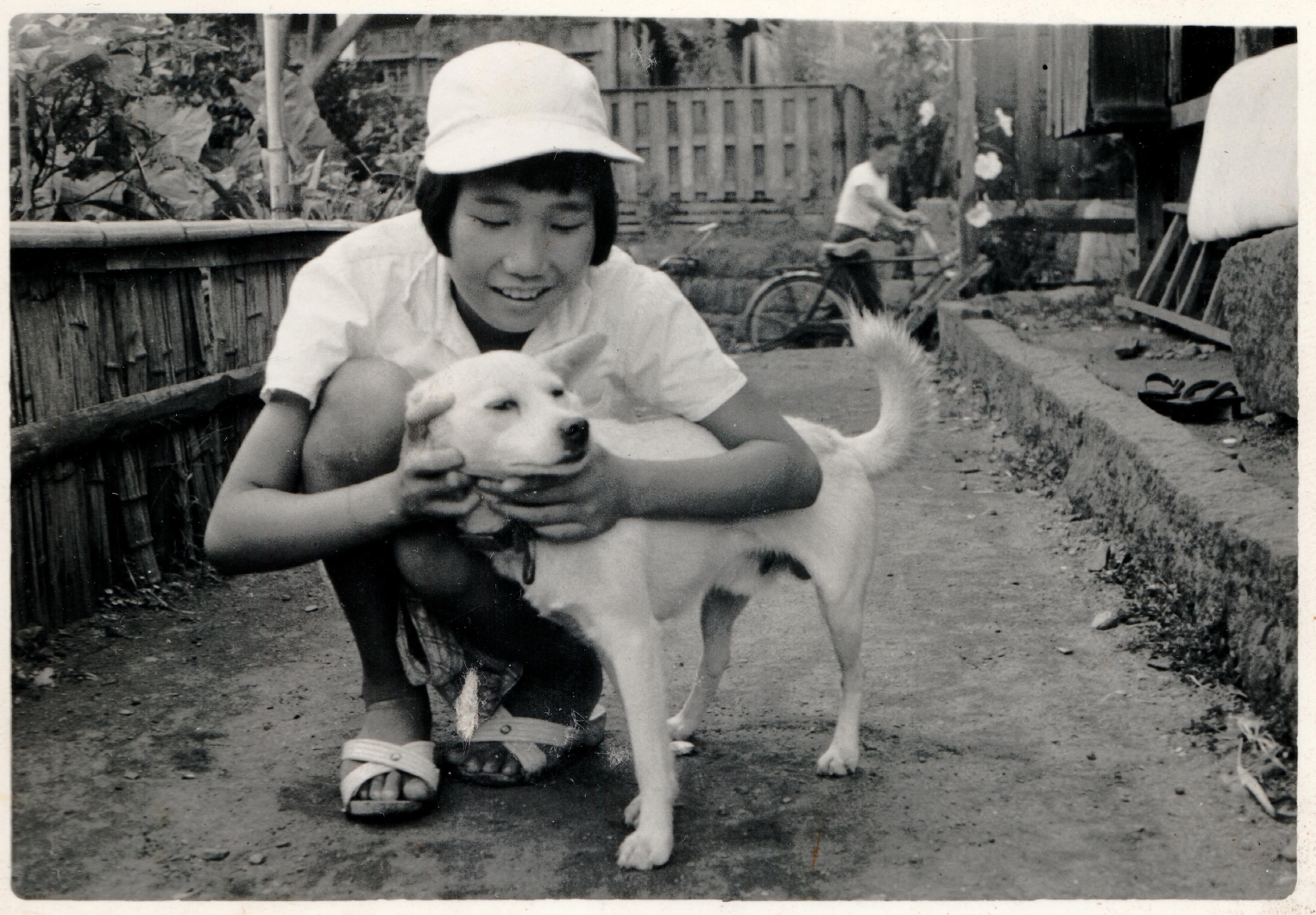
Ritsuko at the age of 14 in Yoshimatsu-cho
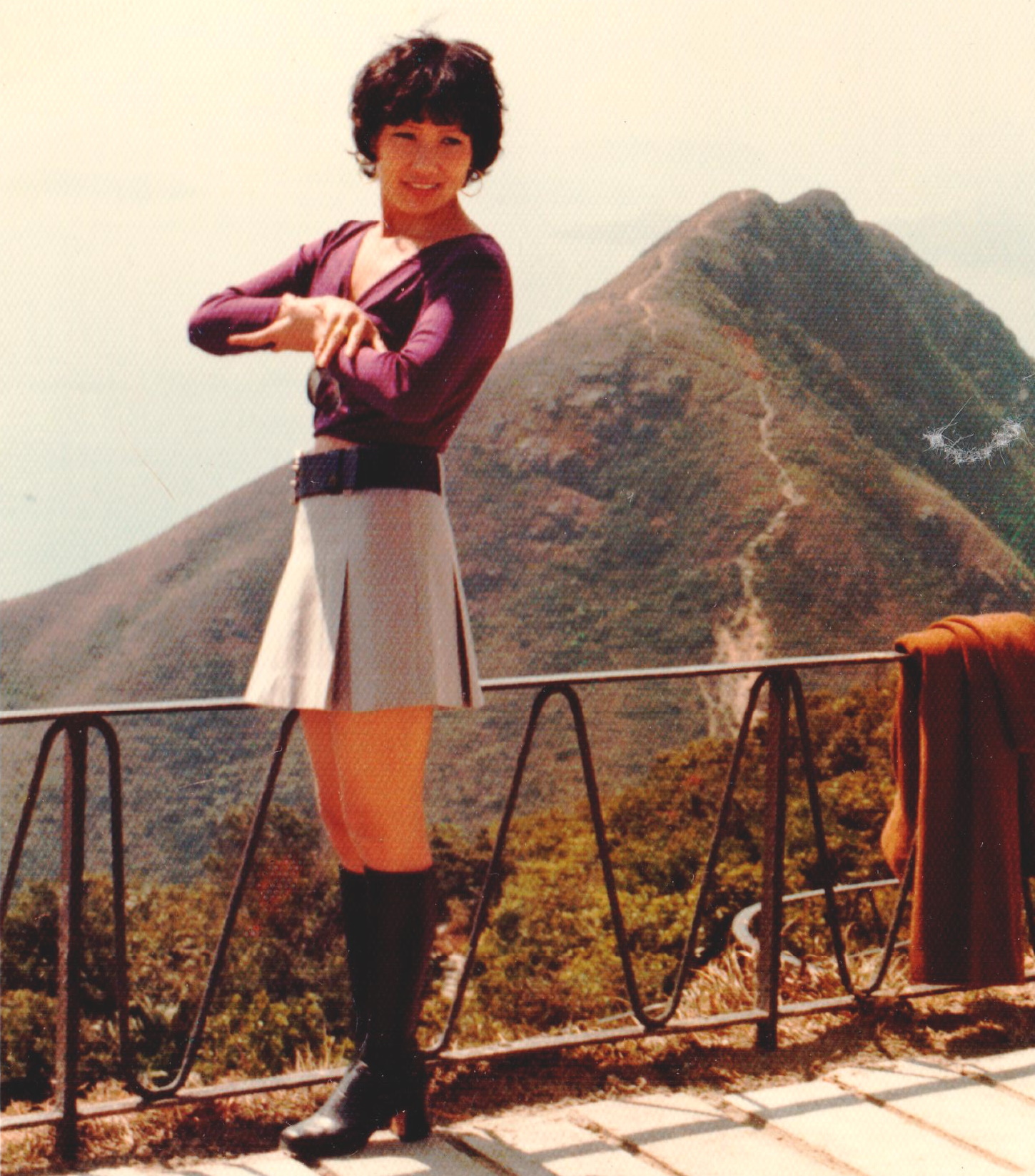
Ritsuko, age 23, during the time that she lived in Hong Kong
Culture shock it probably was ... a girl from a small town in rural Southern Kyushu moves to Tokyo, but it was exactly the kind of culture shock that Ritsuko had been dreaming of. Suddenly, in the summer of 1968, she went from being a high school student, living in a mostly rural area with her parents and younger siblings, to being a young career woman in the biggest city in the world. She was, however, still in a somewhat protective environment. Back then, large companies like Seiyu housed their young single employees in dormitories. Meals were provided at work and in the dorms, and each dormitory was overseen by an older couple who would at least attempt to prevent the young occupants from getting into too much mischief. Of course, Ritsuko and some of her friends would regularly go shopping for new clothes in Harajuku or clubbing in Shibuya or Shinjuku, but the company rules mandated that they return to the dormitory by curfew. So there was structure, and the threat of curfew violators being fired and sent back to their home in shame helped maintain compliance with the rules.
The 1960's and 70's was a time of intensive growth in Japan, and nowhere was that more evident than in Tokyo. Seiyu was opening stores all over the Tokyo metro area, and Ritsuko became a part of a team that would move to a new store before opening, train new employees while setting everything up, and then work in the store through start up. When the store was up and running satisfactorily, the team would then move on to the next new store.
Ritsuko had a lot of fun during that time, and she gained a lot of valuable experience, both professionally and personally. Although she really enjoyed the four years that she spent with Seiyu, in mid 1972 she had an opportunity to spread her wings even more, and try something completely different.
Kanetanaka ( 金田中 ), an exclusive restaurant chain headquartered in Tokyo, was hiring young women to work as wait staff in their Hong Kong restaurant.
Hong Kong in the early 1970's had become a major financial center in Asia, and the Hong Kong Kanetanaka catered to an international exclusive clientele such as corporate C.E.O.'s, high level government officials, and other wealthy influential people who would come there in the course of conducting business. Therefore the image presented by the restaurant was so important that interviews of potential waitresses were personally conducted by the Kanetanaka C.E.O. Ritsuko said that the selection process was interesting in that they were not looking for food service professionals. Instead they wanted to hire young women representative of every day Japanese society who were smart, quick witted, well spoken, and who were able to represent the restaurant and the country of Japan in a very positive manner. Then, the newly hired waitresses would be taught how to perform their jobs by Kanetanaka standards.
Of course, I wasn't there, but I think that her beautiful, ever present smile probably had a lot to do with her being hired. And hired she was. Ritsuko's work background was in retail, with four years of experience working as a member of a retail team, interacting daily with her co-workers and with customers. Among the women hired at that time, there were others with experience in retail trade, but some had other professional backgrounds, including a banker and a teacher. One common trait among them was that all of the women had been successful in their professional careers and that they were now looking to broaden their knowledge and life experience by working in a foreign country. So, after being hired, and after a few weeks training and working in the company's flagship restaurant in Nihombashi, it was off to Hong Kong. Initially, Ritsuko's contract was for one year, but she renewed her contract, and stayed in Hong Kong for two years.
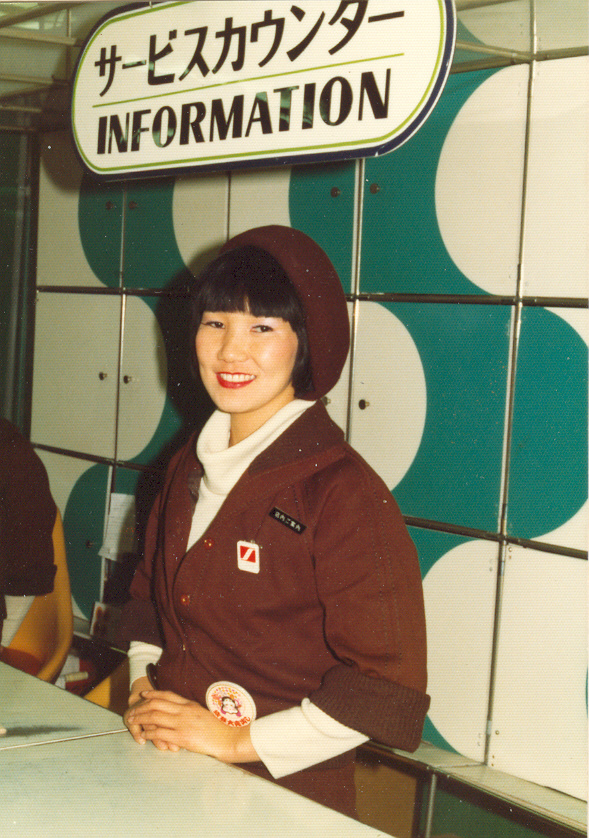
Ritsuko at the Fussa Seiyu Information Counter, approx 1976
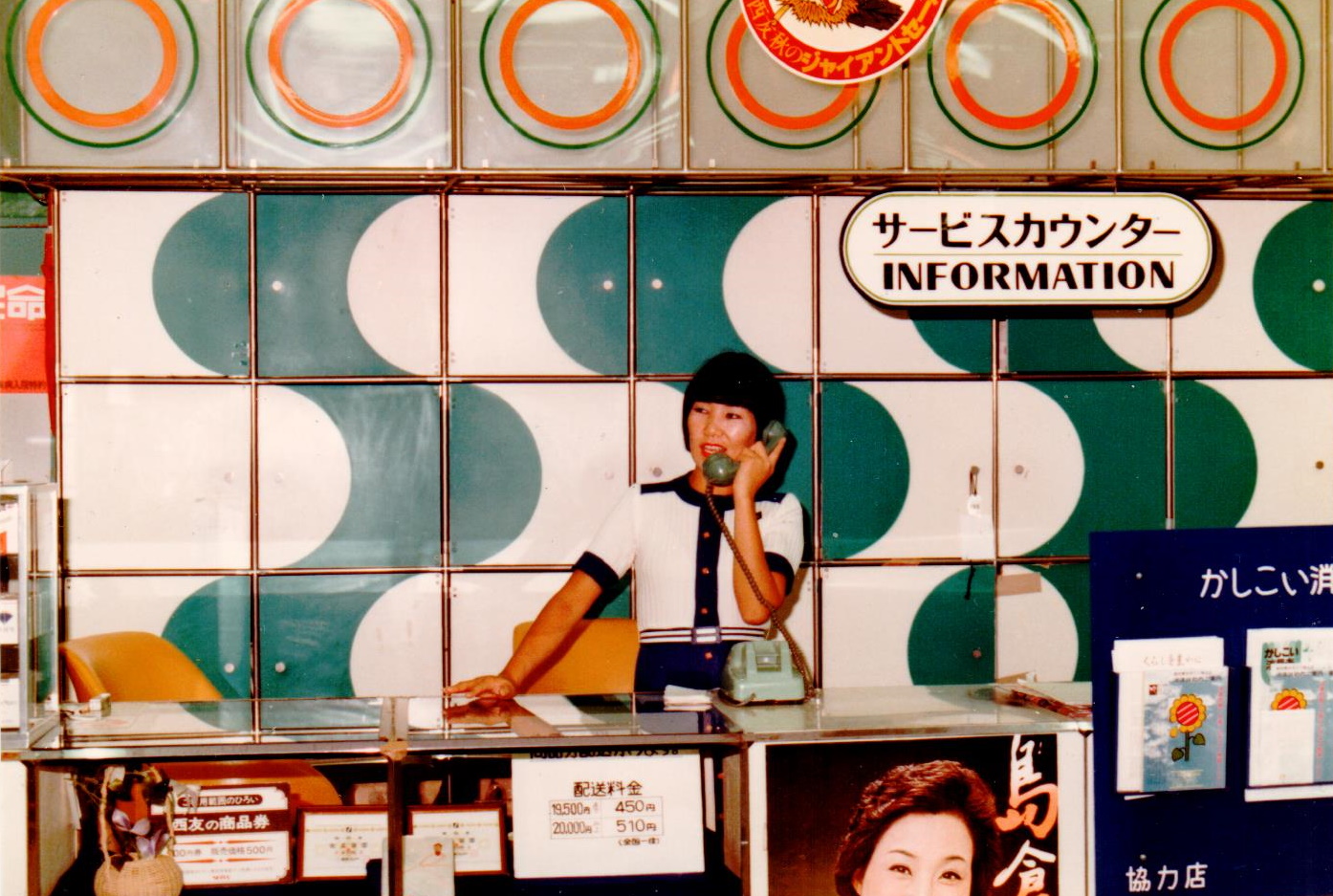
One of Ritsuko's duties was to make announcements to the store in Japanese and English
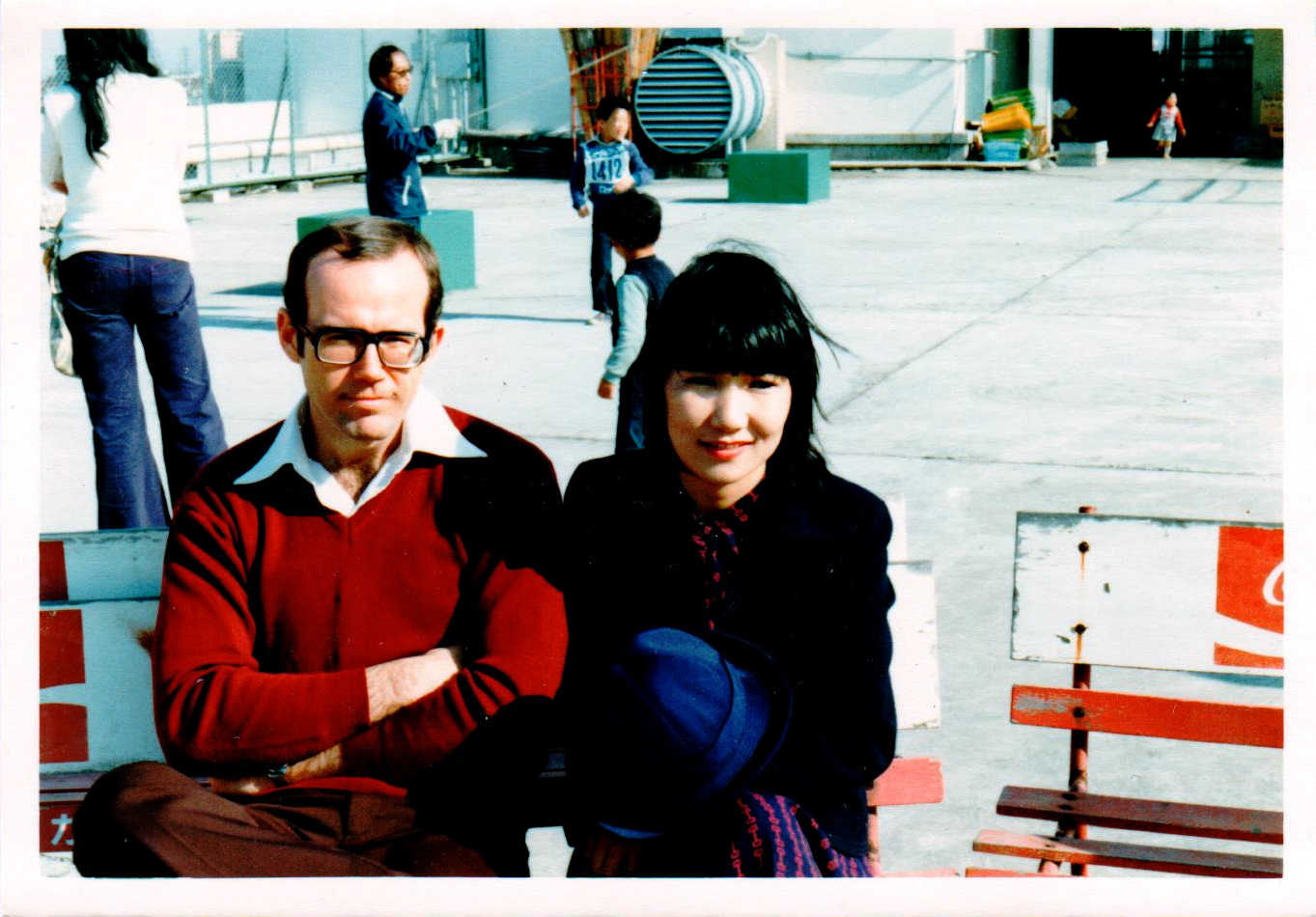
Breaktime on the roof of the Fussa Seiyu store, early 1978
Although her fluency in English was not a prerequisite for employment, having that capability was a plus. Those who could speak English were assigned to a group who would focus on serving foreign clientele. Also, in order to polish their language skills, the company hired the services of a British lady, the wife of a medical doctor in Hong Kong, to tutor the wait staff. When Ritsuko and I first met, only a few months after her return from Hong Kong, I was intrigued as to why she spoke English with a slight British accent. Also, I had learned that after returning to Japan in mid 1974, with the experience of studying English from a most articulate tutor and conversing daily in English with the clientele of the restaurant being still fresh in her mind, Ritsuko tested for and was awarded a Second Level certificate from the Japan Ministry of Education, Society for Testing English Proficiency.
As I mentioned earlier, knowing Ritsuko's background, I had an idea for what might be a good opportunity for her. In 1973, when I first arrived at Yokota, I noticed that an American woman worked in the Fussa Seiyu store at the Information Counter. I thought at the time, well that certainly makes sense because many people from the base, who speak and read absolutely zero Japanese, sometimes shop there, and probably need assistance. Recently, however, when I went to Seiyu, I never saw the American woman, so I figured that she had moved on.
So, I suggested to Ritsuko that she go to Seiyu, and see if they would be interested in hiring her to work at the Information Counter. The next day, she did just that, and the store manager immediately recognized that with her experience and skills, she was a perfect fit for the job. She was hired the same day, and then for the next three years, Ritsuko worked at the Fussa Seiyu store's サービス カウンター (Information Counter) .
For that time and place, this was the perfect job for Ritsuko. In her role at the store, she really didn't have to perform any physical labor. Mainly, she and her fellow Information Counter attendants sat at a long counter near the main entrance, and assisted people by directing them to the location of whomever or whatever they were seeking to find. Frequently, they had to make announcements on the store's public address system, and if there were foreign customers in the store, Ritsuko would make the announcement in Japanese and English. Another of their duties was to manage the many outside vendors who would sell their goods outside the store.
Sometimes my job required me to work around the clock for a few days at a time, pretty much living at the shop, but ordinarily my work day started at 8AM and ended at about 4PM. Ritsuko started later in the morning than I did, and she typically worked into the early evening. Unless the weather was inclement, she would usually ride her bicycle to work. On the days when the weather was uncooperative she would ride the bus. From our front porch, we could see the pedestrian gate in the nearby perimeter fence, and a bus stop was next to the gate. We seldom ate lunch together on work days. I wore fatigues in my job, and back then military personnel were prohibited (or at least strongly discouraged) from entering off base businesses while in fatigues. So, I typically would either go home or to the chow hall for lunch. After work I would usually go for a run or visit the gym. Afterward, I would drive to Seiyu, put Ritsuko's bicycle in the back of our car, and wait for her to finish work. I became a regular at the store's coffee shop in the early evening hours, becoming acquainted with many of the people in the store, and was treated very well by everyone.
I don't remember exactly how much she was paid at her Seiyu job, but I do remember that at the time, we both thought that it was a decent wage. Of course, she was paid in Japanese Yen, and I was paid in US Dollars. After she began her job, we never had to convert any of my pay to Yen. Additionally, with the exception of the groceries that we bought at the Commissary, fuel for the car, clothes for me at the BX, and a few more odds and ends on base, most of what we bought, including many grocery items, was purchased on the Japanese economy, therefore most of our routine expenses were paid by Ritsuko's salary. As a result of that, over the next three years we were able to bank most of my salary, providing us with a cash cushion that helped make transitioning into civilian life a little less stressful.
Travel
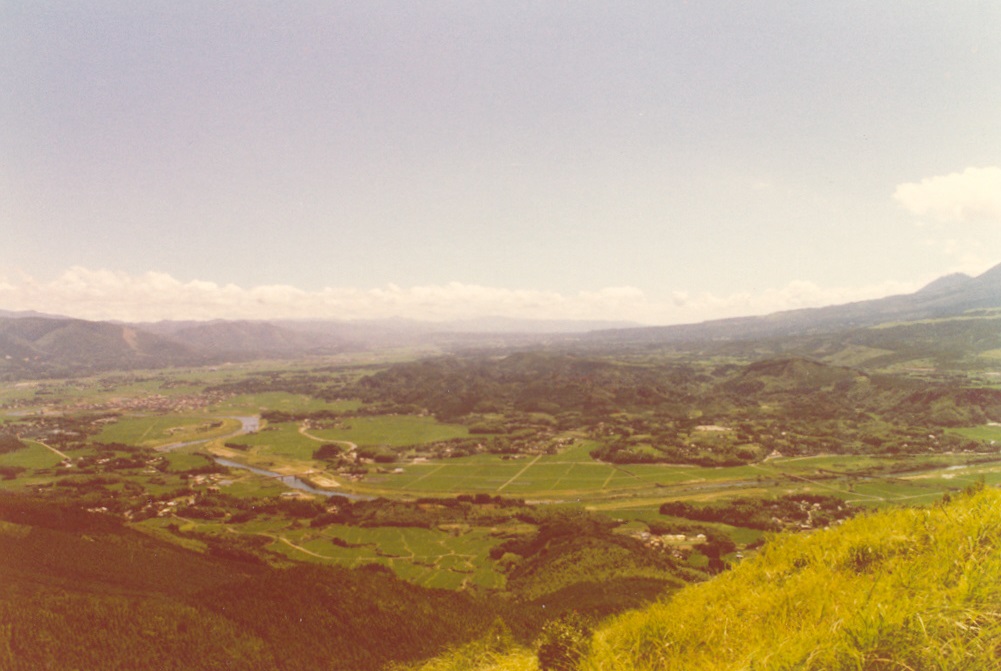
Ritsuko's hometown, Yoshimatsu-cho, on the Sendai River in rural Kagoshima Prefecture.
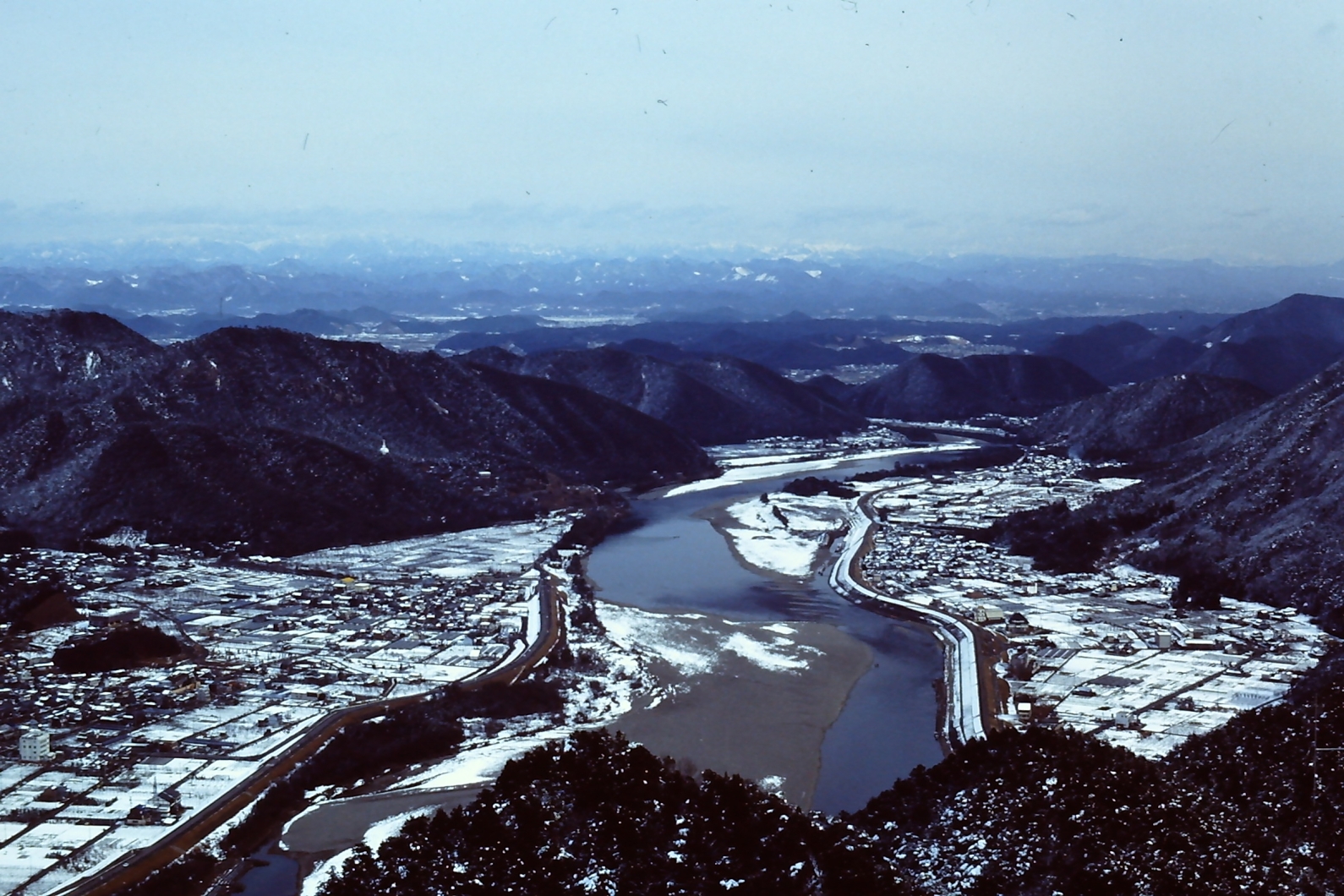
The Kiso River as seen from the tower of Inuyama-jo, a 16th century castle near Gifu.
Ritsuko and I really enjoyed traveling in Japan. With Tokyo being just an hour or so away, we could easily spend our days off happily wandering through the city, enjoying the seemingly infinite variety of shops, parks, shrines, museums, and food, but beyond Tokyo there were so many other interesting places to visit that were just a few hours away by train or car. Needless to say, we ventured out as often as we could. Most of our trips were just for a day or perhaps overnight during a weekend if I was not on standby. One of our favorite short trip destinations was pottery shopping in Mashiko, Tochigi prefecture, a town famous for pottery produced by many artists, collectively known as Mashiko-yaki. Another of our favorites was to drive to Mount Fuji for a picnic lunch or camping overnight on the shore of one of the lakes at the base of the famous mountain.
Of course, we also took a few longer trips. One of our first trips together after getting married was to Osaka, where we visited Ritsuko's older brother and his wife, as well as three of her aunts. Ritsuko's parents visited at the same time, and together, we toured Kyoto, Nara, and Koya-san (Mount Koya).
Later, we visited Ritsuko's parents at their home in Yoshimatsu-cho, in the beautiful lush fertile valley of the Sendai River in Kagoshima Prefecture, which became one of my favorite places to visit. We would spend days there in the hot summer. I would often nap during the heat of the day, resting on the tatami floor, while dozing in the warm summer breeze that would gently flow through the house. It was such a peaceful place, and I felt so much at home when staying there.
Of the other places where we visited, one of the more memorable trips was to Gifu. Anywhere you go in Japan could be called historic, but it was between Gifu and Lake Biwa, where, in the year 1600, the defeat of the army of a coalition of Toyotomi loyalist clans by an opposing force of armies under the command of Tokugawa Ieyasu in the Battle of Sekigahara led to the end of the Sengoku Period and to the eventual establishment of the Tokugawa Shogunate. A well preserved iconic castle of that period, located to the southeast of Gifu, Inuyama-jo, stands atop a hill on the bank the Kiso River. Standing in the tower of the castle, looking out at the river valley and surrounding mountains, one could imagine what the samurai of the era would have seen as they watched the approach of opposing armies.
We stopped at a cotton field in South Texas for Ritsuko to examine, and watched some daredevil crop dusters.
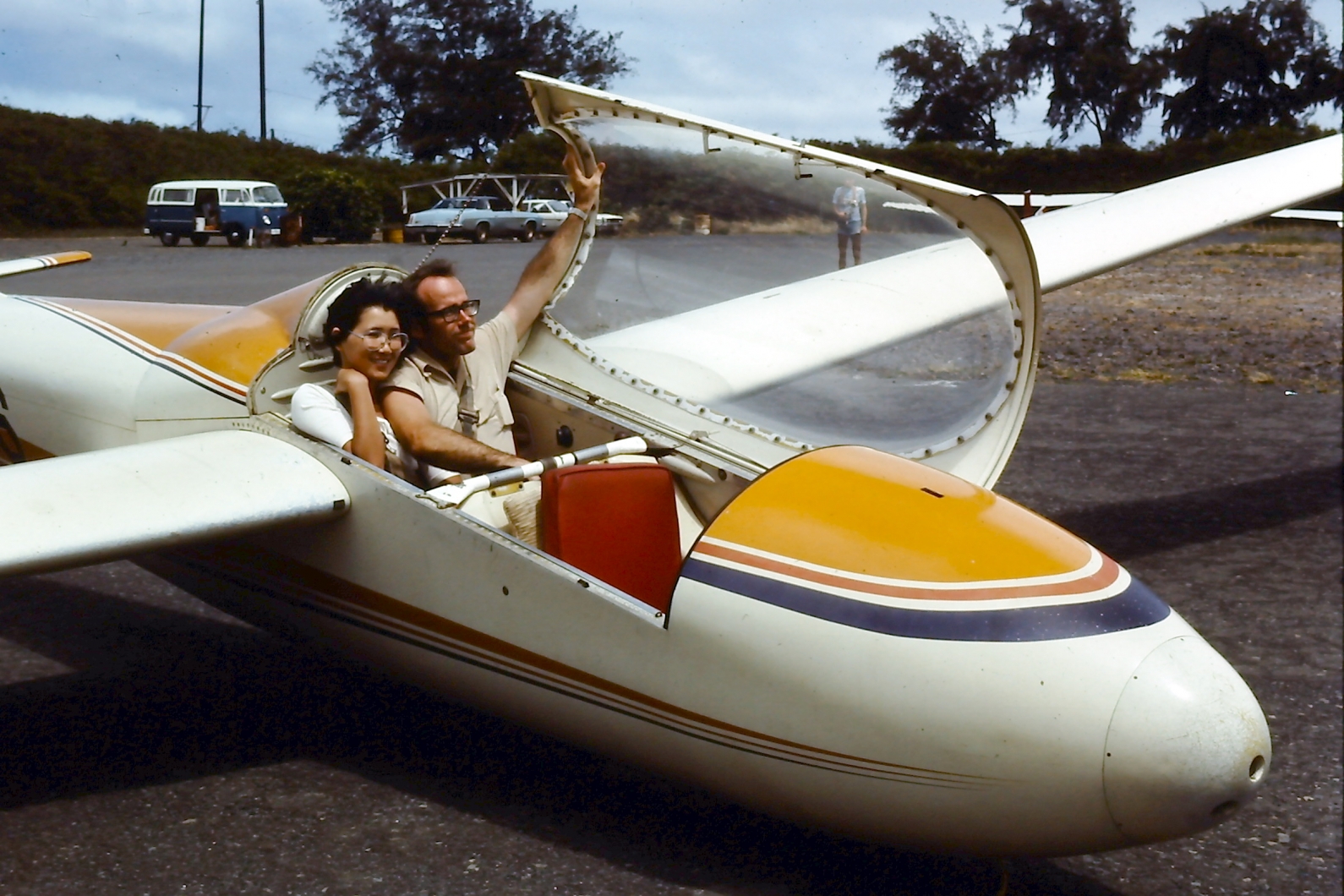
Preparing for a ride in a glider at Dillingham Air Field, Oahu 1977
By the summer of 1977, we decided that it was time for us to travel to the United States. We had been married for over two years, and although I had met most of Ritsuko's family, she hadn't met any of mine. Also, Ritsuko had never been to the United States, and it had been four years since I was there. It was definitely time for a visit
Thus we began to plan a trip to my homeland. I had plenty of leave time saved, so we decided to make it a month long trip beginning in early August, spending approximately 3 weeks in Texas, and with a one week layover in Hawaii on the return.
We flew from Tokyo to San Francisco, and then to Dallas. The new airport, DFW, was still under construction when I last visited Dallas in June of 1973, so arriving there on this trip was my first encounter with this massive sprawling airport. I had called my parents from San Francisco to give them our flight information, so they were there to meet us. Everything and every place was a new experience for Ritsuko, and while I enjoyed watching her reaction to so many new experiences, I also found myself experiencing some degree of culture shock since I had been out of the country for four years.
My parents became like ambassadors of Texas, wanting Ritsuko to see as much of the state as possible during our stay. Of course one of the first things that my father insisted upon was that he get his new daughter in law outfitted with some proper western gear, including Wrangler jeans, Stetson hat, and of course, cowboy boots. Ritsuko, being one who loves to shop, was definitely up for the experience.
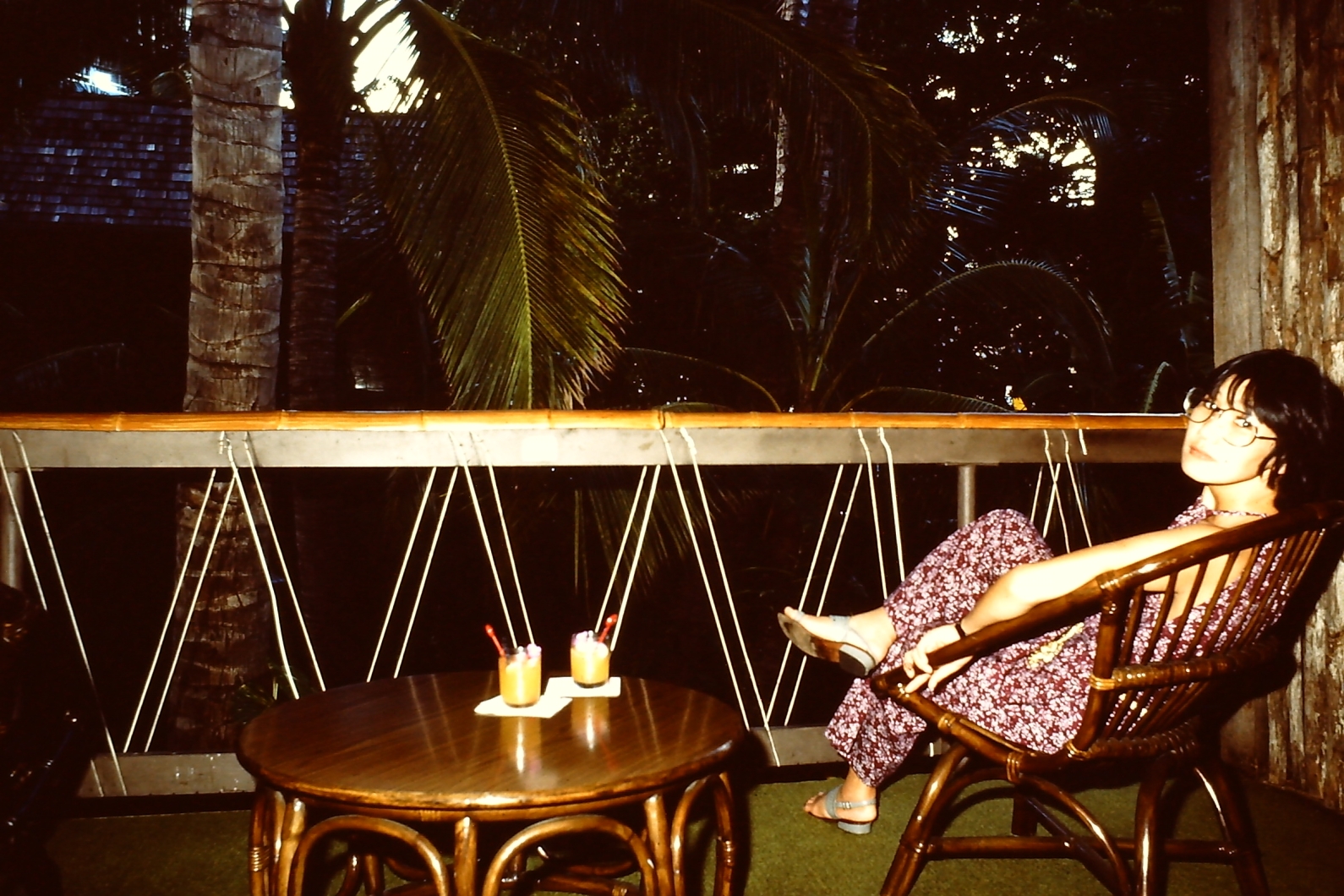
Ritsuko enjoying a cocktail on the balcony of our hotel room, Waikiki 1977.
We had a great time, and I was very happy that we decided to visit. Of course I wanted Ritsuko to meet my family, but also I was glad to be able to see with my own eyes how good the economy of the area was at that time, and I was happy to see that so many people our age were enjoying the prosperity of the era and living well. Soon, it was time to leave for Honolulu, our last stop on the way home to Japan.
Although we had a great time visiting my family, Ritsuko and I were really glad to have a few days to ourselves in Hawaii. I had been there many times, and was pretty familiar with the Waikiki area of Honolulu. In planning the trip, I had booked a room in a small hotel a few blocks from the beach. In those days, small, clean, inexpensive hotels were plentiful. They didn't have beachside views, but the price was right, especially with a military discount, and the beach was only minutes away.
This was our first tropical beach holiday, and we proceeded to make the most of it. It was a good opportunity to have some fun in the surf and sun, while unwinding from our trip to Texas, relaxing in preparation for returning to our daily lives, and providing us with some much needed time to step back and reflect on our lives in general.
,
Deciding to leave Japan and the Air Force
For the most part, my job had become routine. It was no longer challenging, and I had fallen into a state of complacency. People in my AFSC typically became "stuck" at the rank of Staff Sergeant for several years. I had been fortunate enough to have made Staff Sergeant on the first cycle that I was eligible, so By mid 1977, on the first cycle when I was eligible to test for Tech Sergeant, I had over 3 years time in grade, but I knew that it would be mathematically impossible for me to advance to TSGT for at least another year, and most likely for another two years. If I was going to stay in the Air Force, I knew that I needed to make a change ... perhaps cross train into an AFSC where I would have better chances for advancement, or perhaps try for a commission. Prior to enlisting, I had completed two years at Texas A&M University, and I had taken a few college courses while in the Air Force, so a degree was within reach, therefore I thought that applying for an education and commissioning program would be a possible option. If I was to make the Air Force a career, finishing my bachelor's degree and becoming a commissioned officer was probably the best path to take. Actually, I knew a few people in my AFSC who had done just that. I thought that it was a smart move on their part, but for me the big question remained; did I really want to stay in the military?
After high school, I had entered college on a four year Army ROTC Scholarship; my only goal was to become an Army officer. During my sophomore year, disillusionment with the war had caused me to rethink that goal, and change direction. I felt as though I could not be in a leadership position in the Army, fighting in a war in which I thought that U.S. involvement was a mistake. I gave up my scholarship shortly after the beginning of the spring semester and left the Corps of Cadets, finishing the school year as a civilian student. Becoming an Army officer had been my only reason for going to college, especially to that one. Now, I no longer had a reason to be there except that I was already enrolled. I knew that I would not return to A&M the next school year, and having no clear reason to pursue any particular field of study, I felt as though it would be a waste of time and money for me to enroll anywhere.
In the Fall of 1970, as a college dropout, I had no deferment and was susceptible to conscription. In the Draft Lottery of 1969, I had been assigned a low number, and no longer having a student deferment, I was, after a few months, reclassified by the Selective Service System as 1-A (available for unrestricted military service). Being in imminent danger of being drafted, my life was about to change. QUICKLY, I had to make a critical decision, and therefore enlisted in the Air Force in December 1970.
So, there I was, August 1977, and once again needing to make a critical decision ... stay in or get out. Regardless of whether Commissioned Officer or Enlisted NCO, did I really want to stay in the military? I felt that if I were to choose either career military path at that time, it would need to be for keeps, and whatever happened, even if I found myself in circumstances that seemed intolerable, I would have to just ride it out. Yeah, that's life, and military or civilian, it can happen regardless of your career, but if I stayed in the military, my choices for avoiding those circumstances would be more limited than if I was a civilian. I knew that I really needed to get out.
Ritsuko and I spent many hours discussing the pros and cons of our choices. That lovely young woman I married ... she was so supportive. This was a difficult decision, but both of us had individually faced difficult decisions in our lives. Now we were together, and our union made us each stronger as we worked toward making this decision together. We spoke at length about the people our age we saw in Dallas, who were enjoying a happy and prosperous life, and I felt confident that I could find a job, given my Air Force training and experience as a technician repairing complex electronic and electro-mechanical equipment. Neither of us liked the degree to which a member of the armed forces must commit, and the lack of freedom in making choices that affect their lives. It did however, seem to offer job security, but was that enough to commit. We came to the realization that whatever course we chose, job security is just an illusion, for regardless of my career path the future was uncertain, therefore the perception of job security should not become the dominant factor in making our decision. After much discussion, we agreed that I should get out of the Air Force. One potential obstacle to my being able to get out anytime soon was the fact that prior to going on leave, I had extended my overseas tour and my enlistment to 1979.
It was early September; we returned to Japan, and I reported back to duty. Immediately, I set about the task of unwinding extensions to my overseas tour and my enlistment that I had previously secured. When that was done, I had a DEROS of June 1978, and a date of separation of December 1978 (the end dates of the extensions of tour and enlistment that I was currently serving). That left me with insufficient retainability for a stateside assignment upon leaving Japan in June 1978, therefore when the time came for me to get orders for my next assignment, if I declined to re-enlist or extend my enlistment, I would be discharged from the Air Force at the end of my assignment in Japan. And that was exactly what we wanted!
Our end of tour shopping spree and The Princess Chair
At that time, a person of my rank returning to the U.S. after completing a command sponsored tour was eligible to ship 2000 pounds of household goods at government expense. We had acquired a lot of heavy things, mainly pottery, and I was concerned that we would be over our weight limit. It was then when a friend informed me that since Ritsuko was moving the the U.S. for the first time, I should request a dowry allowance. I had never heard of that, but I went to the base personnel office and inquired about the dowry allowance, and sure enough it was a legitimate exception to the weight limit. I applied, and our limit was increased to 5000 pounds. Ok Ritsuko, time for more shopping.
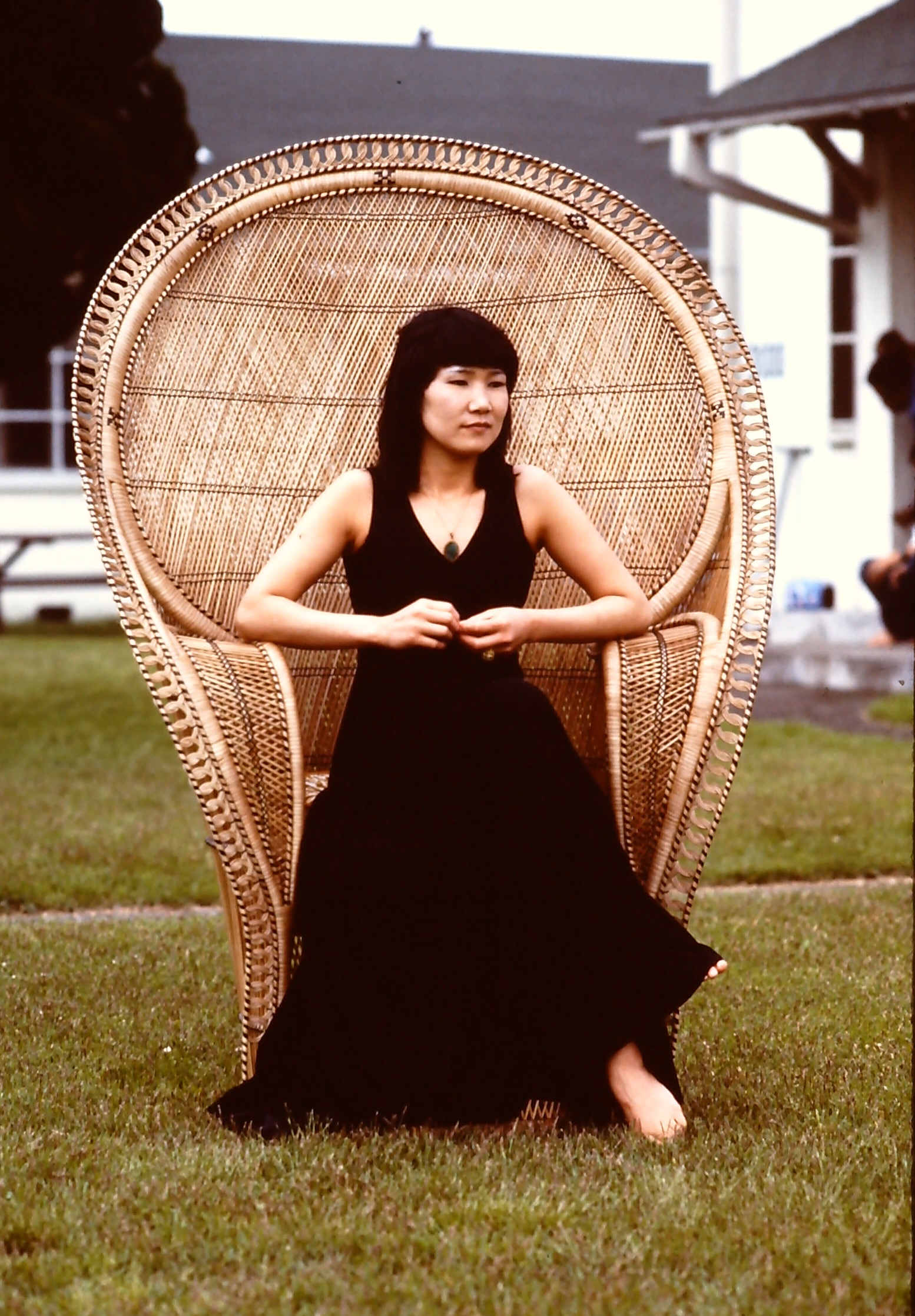
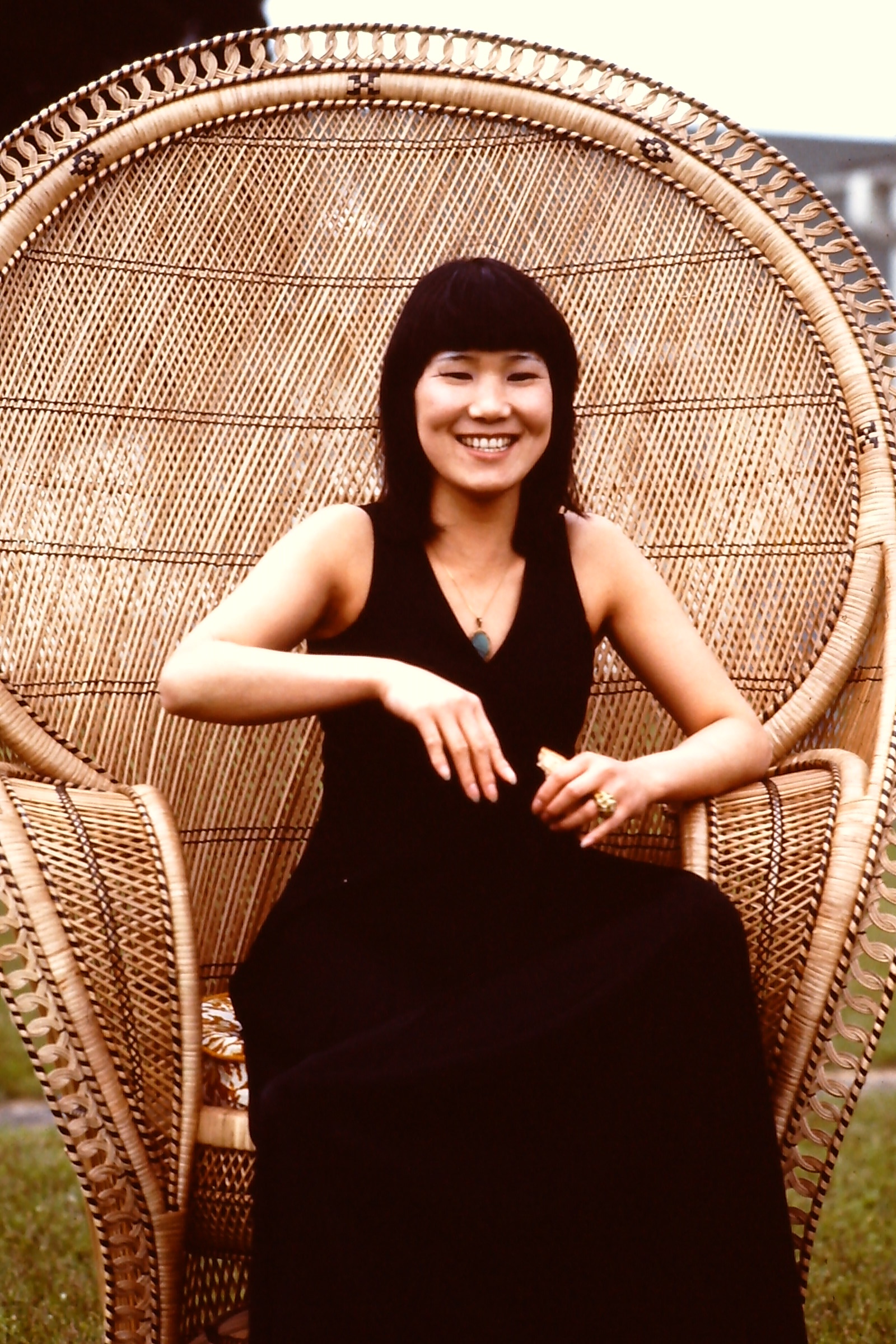
Ritsuko in evening attire (sans shoes) posing in her new princess chair, 1978
It soon turned into a photo shoot in the front yard, Yokota AB West Housing Area, 1978
In addtion to more pottery, one item that Ritsuko wanted to buy before we left for the US was a wicker princess chair, also known as a peacock chair. Chairs like she wanted were made in the Philippines, and were rather difficult to acquire unless you traveled to the P.I. and had the means to transport it back to Japan. Although the BX Bazaar at Yokota sometimes offered other furniture items from the P.I., I had never seen princess chairs there, at least not the big ones like Ritsuko wanted. However, the base exchange at Atsugi NAF would sometimes bring in a few chairs, and offer them in a special first come first serve sale on a Saturday morning.
So, upon learning of an upcoming sales event at Atsugi, Ritsuko and I made plans to be there. We thought that we were being smart by planning to get there half an hour before the store opened, but on arrival, we realized that we were seriously late for the party, because there were already about 20 people in line. We ran from the car, and took our place in the rapidly growing line as our hope of buying a chair that day faded.
The doors opened, and people rushed in, pushing and yelling. What a sight, and sure enough, by the time we entered the store, all that was left of the princess chairs was a bits of straw on the floor where they had been displayed. To add insult to injury, one rather rude, loud woman looked at our disappointed faces as she left the store carrying one of the prized, beautiful chairs, and cackled with laughter, shouting, "I GOT my princess chair". I could see that Ritsuko was sad and a bit peeved over what had just transpired. Giving her a reassuring hug, I whispered in her ear, "Don't worry; we know what to do next time".
Next time was a few weeks later. On the day of the sale, we drove to Atsugi in the dark early morning hours, arriving at the store four hours before opening, we came prepared with coffee, onigiri, and a plan. There was already one couple ahead of us in line, but looking into the store, I could see that there were about 10 of the large princess chairs, so I figured that we should be ok.
We sat and ate our onigiri, knowing that at game time, we would need the energy. As the opening time approached, the line behind us had grown in length and in density. Large aggressive women were already starting to push and shove their way into position to do an end run on customers who were ahead of them and close to the head of the line. Ah, but Ritsuko and I had anticipated this, and had been practicing our playbook for the day.
Seeing the store manager walking toward the front door with his keys, I looked at Ritsuko and nodded my head. She nodded her head in reply as she flashed a cute mischievous grin. No one had expected that Ritsuko would be the blocker and I would be the sprinter, but it had to be that way. If I were to physically block dependent wives from entering the base exchange, I could be charged with assault, but if my wife does it, then she is just shopping. Ritsuko is small, but she is also very strong and quick, and she was damn sure determined to go home with one of those chairs that day. As the door opened, the women to our rear moved like a phalanx of Roman soldiers between the building and the line, pushing people away from the store, but Ritsuko threw some very effective blocks that would make any NFL offensive coordinator proud, finally standing fast in her position at the door foiling the aggressive shopping divas' plan of overtaking our position, and thus allowing me to sprint to the chair display where I quickly secured our prize of the day.
A little roughed up, but none the worse for wear, Ritsuko triumphantly joined me at the checkout counter as we paid for her chair. Then, in a gesture of good sportsmanship and common decency, we quietly and politely left the store, Ritsuko bowing slightly to our fellow shoppers as we carried our newly acquired prized possession to our station wagon. Leaving for home, we happily cruised out the gate of Atsugi NAF and into the countryside of Kanagawa-ken. Ritsuko and I rolled down our windows and shouted in unison, "I GOT my princess chair".
Departure, hope for a bright future
It wasn't long before June arrived, in just a few days, June 13, 1978, I would once again become a civilian. By this time, I had received and accepted an employment offer. I was to be a Field Engineer, assigned to the Houston TX field office of a company that manufactured IBM 3270 compatible computer terminals. Having a job offer was an essential component in getting approval for Ritsuko's immigrant visa so that she could be admitted to the United States as a Resident and be issued a Green Card.
With our household goods and our hold baggage having been packed and carried away, we now were living in the transient family quarters. We were fortunate in that the enlisted quarters were full when we checked in, and therefore we were given a suite in the officers transient family quarters. It was a nice private suite with a bedroom, living room, bathroom, and kitchen. I thought that it was just phenomenal that the Air Force was treating us so well for our last few days in service. We had paid a cleaning service to clean our residential quarters and oversee the out processing housing inspection, so we basically spent our time just visiting with friends, and waiting for the 13th.
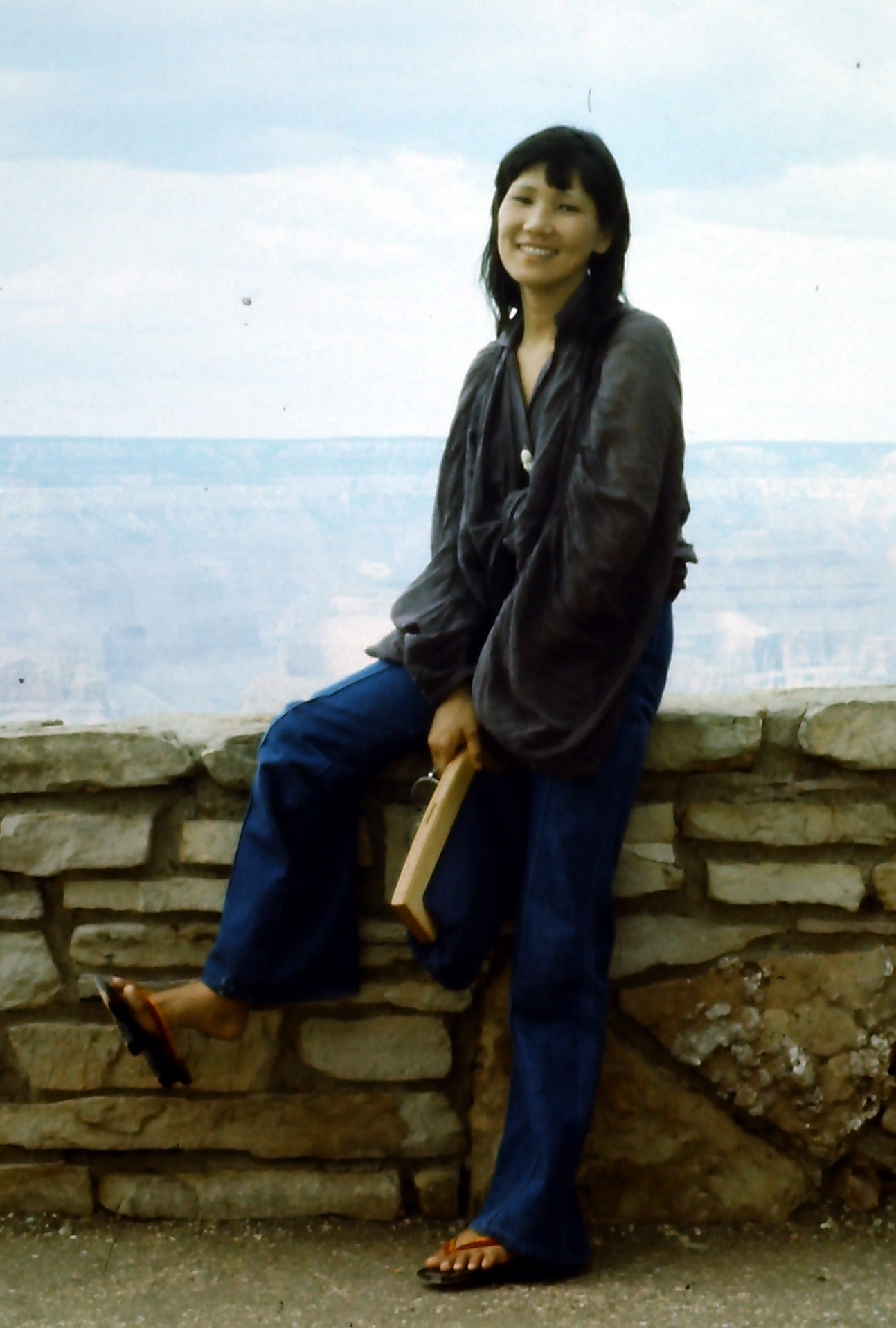
July 1978: We spent 3 weeks in Phoenix so that I could attend technical training at the company headquarters. One of our weekend getaway trips was to the Grand Canyon.
On that day, we packed our bags, and I put on my summer uniform. Ritsuko and I then went to the base personnel office, where we both surrendered our I.D. cards, received my final pay, and I processed out of the Air Force. I had previously gotten permission to separate in country, and then remain in Japan until the end of June. So, we left the personnel office, and walked to the credit union where, using my separation orders for identification, cashed the final pay check, and called a taxi to take us to Fussa Station.
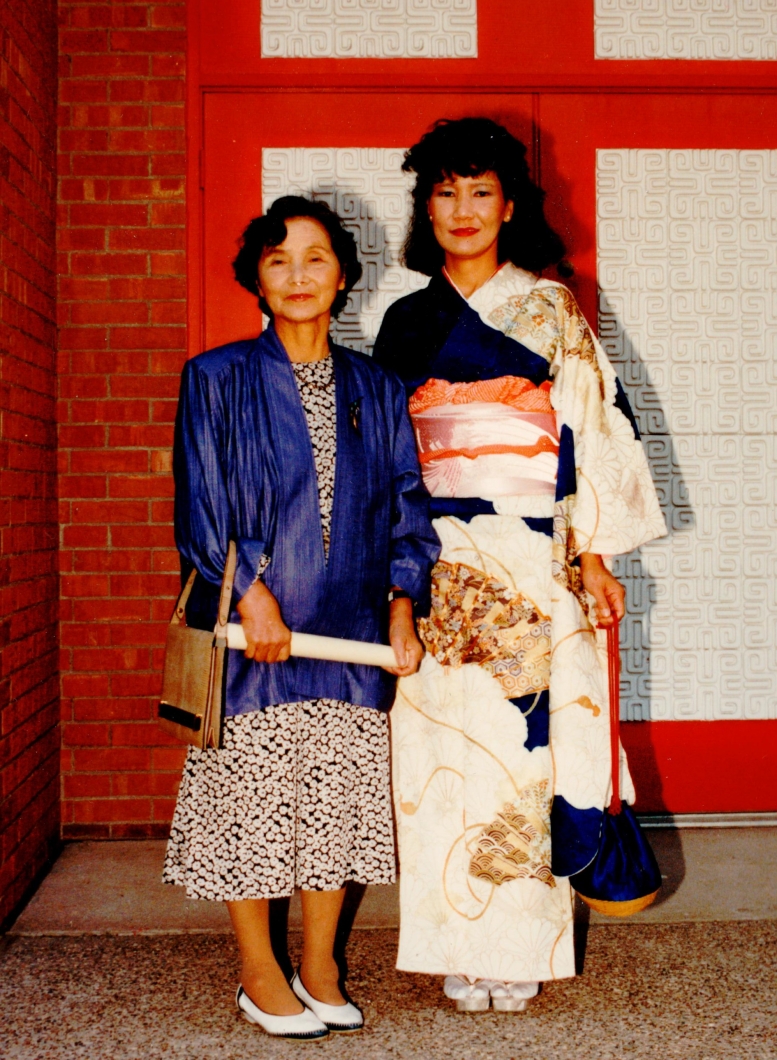
September 1989: After graduation, Dr. Ritsuko, wearing her younger sister's kimono, and her mother holding Ritsuko's diploma.
In the restroom in Fussa Station, I changed into civilian clothes, and placed my summer uniform in my suitcase, never to wear a military uniform again. We then took the train to Tokyo, where we spent the night in a hotel. It all felt so surreal, exciting and somewhat scary; after seven and a half years of active military service, I was once again a civilian. The next morning, we went to Haneda airport and flew to Kagoshima.
We stayed with Ritsuko's parents for the next two weeks. I had some study materials that my future employer had sent. So during the day, I sat on the tatami, once again luxuriating in the warm summer breeze, except this time, insead of napping, I was diligently studying, attempting to learn the basics of IBM Binary Synchronous Communication and IBM 360/370 local channel protocol as a preparatory step for the training classes that I would soon be attending.
Finally, it was time to return to Tokyo, and then to Yokota Air Base, where we would board a military contract flight to Travis AFB, California. Saying goodbye in the Kagoshima airport to Ritsuko's parents was hard. Her mother burst into tears, asking me to take care of her daughter. The future was uncertain, and surely she considered the likelihood of never again seeing Ritsuko. Of course none of us can see into the future, but if she could have, she would have seen that her daughter would not only have the means to return to Japan numerous times to visit, but that she herself would, in just eleven years, visit us in the United States, where she would watch her oldest daughter graduate from Palmer College of Chiropractic as a Doctor of Chiropractic, thus embarking upon a long career of helping people live happier healthier lives.
Epilogue
In telling the story of some of the changes that Ritsuko and I have experienced, the focus of course shifts from one of us to the other depending upon which one of us is the protagonist of the particular event. However, the story here has never really been about one of us or the other but about us as a single entity. For since the day that we met, and with all of the changes that we have experienced, Ritsuko and I have been, and we remain, a single entity ... us.
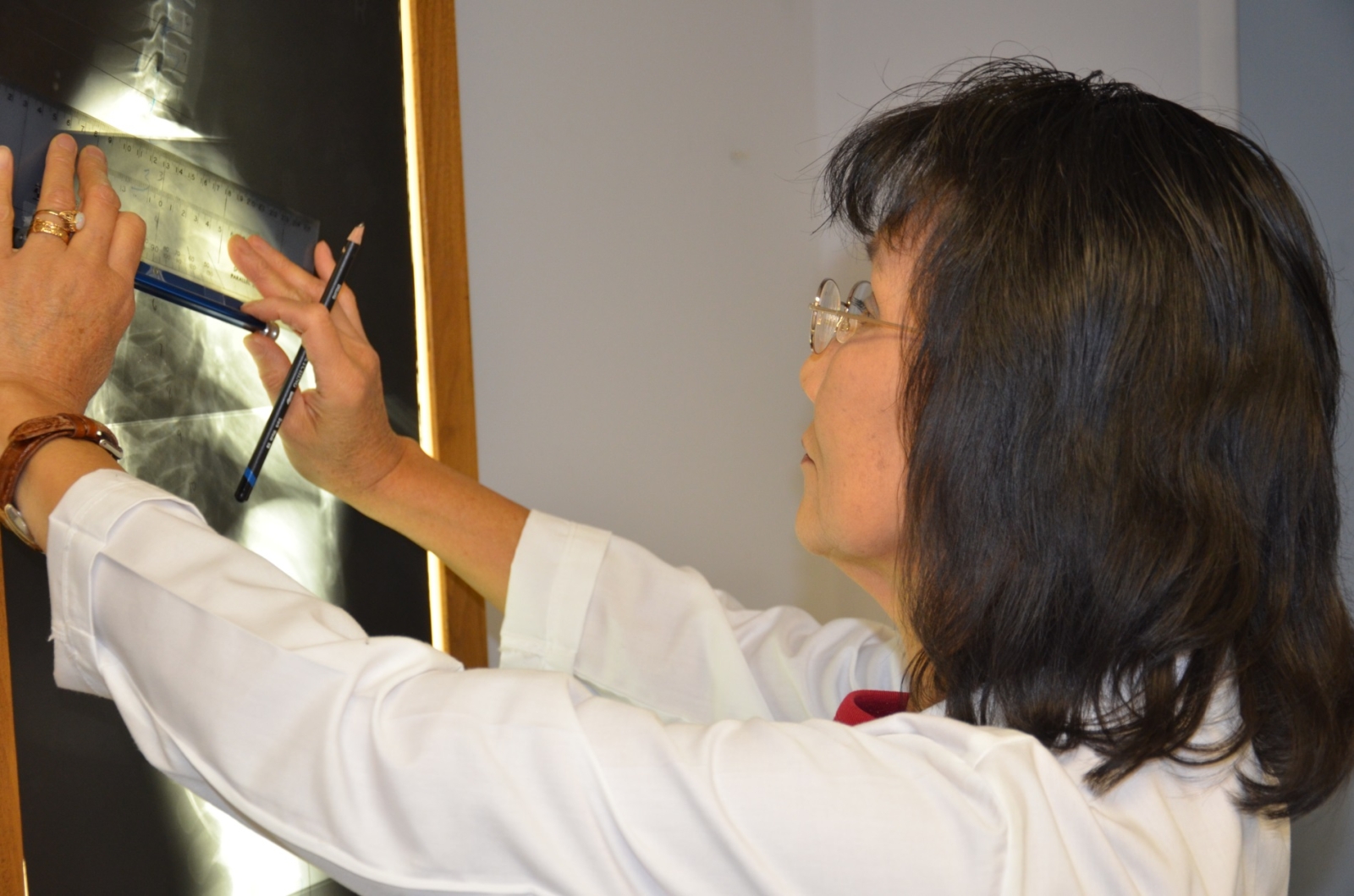
Dr Ritsuko analyzing a patient xray
Writing this story has most certainly been a labor of love, in fact I really shouldn't call it a labor at all. These words come from the heart, especially at this time as she and I reflect on her incredible accomplishments in her career. It has been a time of reflection because in mid 2022, Dr. Ritsuko, after 33 years as a practicing Chiropractor, 31 of which were in her own practice, decided to retire. Therefore we have spent the past several months closing her office, so that she can settle into what will be her next chapter, whatever that turns out to be.
Thank you for reading.
Ritsuko and Bob
PS: If you are curious about how Ritsuko and I first met, go to Ritsuko's website, RitsukoCrabb.com, and read her story, "My First encounter with Robert".